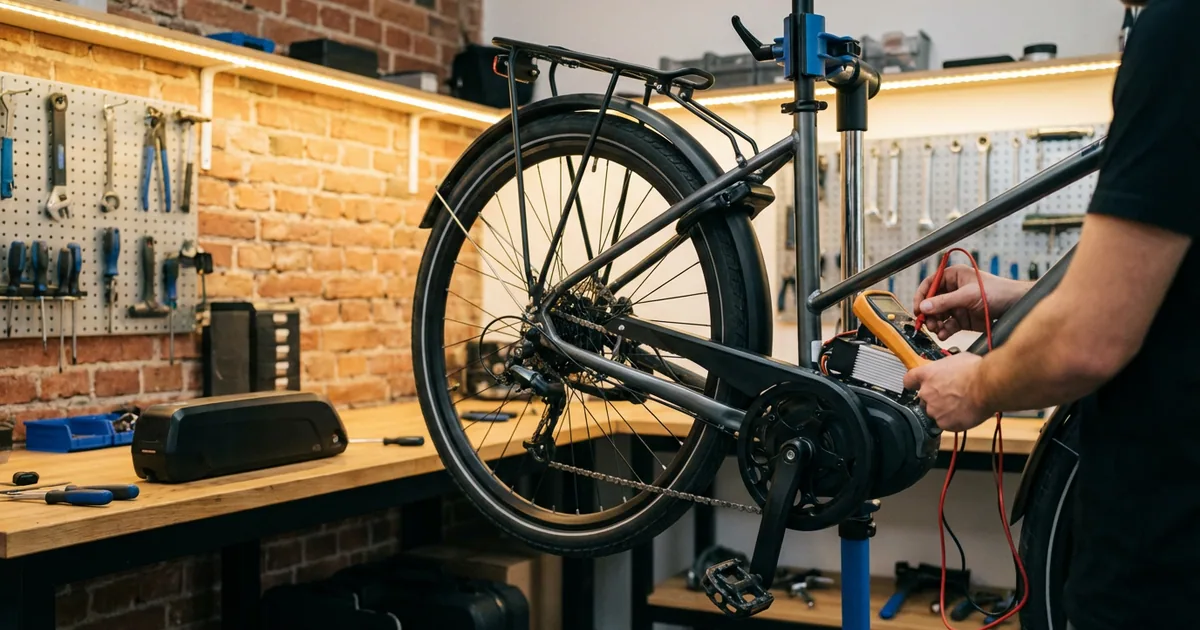
E-Bike and Scooter Repair: Customer Communication That Works
E-bikes are the fastest-growing segment of the bicycle market in Canada. Sales have tripled since 2020. Cities like Montreal, Vancouver, Toronto, Ottawa, and Calgary are building dedicated cycling infrastructure, and e-bike commuters are growing in every province.
With growth comes repair demand. And e-bike repair is different from traditional bike repair in ways that directly affect how you communicate with customers. The bikes cost more. The technology is less understood. The anxiety is higher. And the shops serving this market are often new, which means trust hasn't been established yet.
This guide covers how to build a customer communication system for an e-bike and electric scooter repair shop — one that manages expectations, reduces anxiety, and builds the trust that turns first-time customers into regulars.
The e-bike repair boom
The numbers tell the story:
- Canadian e-bike sales exceeded 200,000 units in 2025, up from roughly 60,000 in 2020.
- Average e-bike price: $2,500–$5,000 for mid-range models. Premium models reach $8,000–$12,000.
- Battery replacement cost: $500–$1,500 — the single most expensive repair.
- Warranty gap: Many direct-to-consumer brands (Rad Power, Lectric, Aventon) sell online with limited local service options. Their customers need independent repair shops.
There's a structural mismatch: hundreds of thousands of e-bikes on Canadian roads, and not enough qualified shops to service them. If you're in this market — or entering it — the demand is there. The question is whether your customer experience matches the premium price point these owners paid.
What are the common repairs and turnaround times?
E-bike repairs fall into two categories: the mechanical (same as traditional bikes, slightly different) and the electrical (completely different).
Mechanical repairs
- Flat tires / tube replacement: 30–60 minutes. E-bike tires wear faster due to the motor's added weight and torque. Rear wheel removal is trickier with hub motors — it involves disconnecting the motor cable.
- Brake pad / rotor replacement: 45–90 minutes. E-bikes use hydraulic disc brakes almost universally. They wear faster because of the bike's higher average speed and weight.
- Chain and drivetrain: 1–2 hours. Mid-drive motors put extra stress on the chain and cassette, leading to faster wear.
- Full tune-up: 1.5–2.5 hours. Same as a traditional bike tune-up, plus checking all electrical connections, updating firmware, and verifying motor calibration.
Electrical repairs
- Battery diagnostics: 2–4 hours. Requires cell-level voltage testing, sometimes a full charge/discharge cycle. This is the job customers are most anxious about.
- Battery cell replacement: 1–3 days. Sourcing replacement cells, disassembly, soldering/welding, reassembly, and testing.
- Motor controller reset / replacement: 1–4 hours for reset, 1–3 days for replacement (parts dependent).
- Display unit replacement: 30–60 minutes if parts are in stock. 1–2 weeks if ordering from the manufacturer.
- Wiring harness repair: 1–3 hours. Water ingress and connector corrosion are common, especially in Canadian winters.
The key insight: electrical repairs involve more diagnostic time and more parts waiting. A traditional bike shop might turn a job in a day. An e-bike shop might need 3–5 days for the same customer visit because of battery testing and parts sourcing. That extended timeline makes proactive communication essential.
Workflow stages for e-bike shops
Standard repair shop stages don't capture the e-bike workflow. You need stages that reflect the diagnostic-heavy, parts-dependent reality of electrical repairs.
Here are recommended stages for an e-bike repair shop using a tool like FixyFlow:
- Received — Bike checked in. Customer gets a text with tracking link.
- Initial Assessment — Visual and mechanical inspection complete. You've identified what it needs at a high level.
- Battery / Electrical Diagnostics — This is the stage that kills anxiety. When the customer sees “battery diagnostics in progress,” they know you're actively working on their most expensive component.
- Quote Sent — Awaiting Approval — You've priced it out and sent the customer a breakdown. They need to approve before you proceed.
- Parts Ordered — The second most important update. Without it, customers assume their bike is sitting untouched.
- Parts Received — Repair Scheduled — Parts are in. Repair is queued. They know it's happening soon.
- In Repair — Active bench work.
- Testing / QC — Post-repair verification: test ride, battery load test, brake check.
- Ready for Pickup — Come get your bike.
Each stage change triggers an automatic text. The customer never has to call and ask what's happening. For guidance on designing stages that match your specific workflow, see our bike shop communication guide and workflow stages template.
Battery diagnostics and customer anxiety
Battery problems are the most stressful repair for e-bike owners. Here's why:
- Cost anxiety: A new battery costs $500–$1,500. That's 20–40% of what they paid for the entire bike.
- Uncertainty: “Is my battery dead or just needs a reset?” They genuinely don't know, and the internet gives contradictory answers.
- Replacement scarcity: Some manufacturers have discontinued models, making OEM batteries unavailable. Third-party replacements vary in quality.
- Safety fears: Lithium battery fires make the news. Customers worry about whether their battery is safe to keep using.
Your communication during battery diagnostics needs to be more detailed than for any other repair type. Here's what to include in the diagnostic update:
- What you tested: “We ran a full cell-level voltage check and a load test on your battery pack.”
- What you found: “3 of 40 cells are below acceptable voltage. The pack still charges but loses range faster than normal.”
- What you recommend: “We can replace the 3 weak cells ($350) or replace the full pack ($1,100). Cell replacement restores about 85% of original range.”
- Safety assessment: “The battery is safe to use in its current state — it just won't hold a full charge.”
This level of detail takes 2 minutes to type. It saves 15 minutes of phone calls and prevents the 1-star review that starts with “they had my bike for a week and nobody told me anything.”
Communicating repair costs
E-bike repairs are expensive compared to traditional bike repairs. A brake job on a regular bike might be $40. On an e-bike with hydraulic disc brakes and a hub motor wheel removal, it's $80–$120. Battery work can run into four figures.
How you present costs matters as much as the number itself:
Break it down
Don't send “Total: $450.” Send:
- Battery cell replacement (3 cells): $210
- Labour (disassembly, soldering, reassembly, testing): $180
- Load test and QC ride: $60
- Total: $450
Transparency builds trust. When customers see what each line item covers, they understand the value. When they see a single lump sum, they compare it to the $30 tune-up their acoustic bike gets.
Give options
Whenever possible, present two choices:
- Option A (targeted repair): Replace 3 weak cells. $450. Restores ~85% range.
- Option B (full replacement): New battery pack. $1,100. Full factory range, 2-year warranty.
Giving options makes the customer feel in control. It also anchors the repair cost against the full replacement cost, making the repair feel more reasonable.
How do you build trust in an emerging industry?
Traditional bike shops have decades of community trust. E-bike repair is new. Many shops have been open for 2–3 years or less. Customers are naturally cautious about handing over a $4,000 bike to a shop they've never used.
Trust-building strategies for new e-bike shops:
Certifications and manufacturer partnerships
Get certified by the motor manufacturers you service most. Bosch eBike Service Certification, Shimano STEPS certification, and Bafang authorized dealer status all signal competence. Display these in your shop and on your website.
Transparent communication from intake to pickup
The single best trust signal is keeping the customer informed at every step. A tracking link that shows their bike moving through stages — from received to diagnostics to parts ordered to repair complete — demonstrates professionalism that many established bike shops don't offer.
This is especially powerful for first-time customers. When they check their tracking page and see “Battery diagnostics in progress,” they know their bike isn't sitting forgotten in a corner. That one update can be the difference between a nervous phone call and a relaxed wait.
Before-and-after documentation
For major repairs (battery replacement, motor swap, full overhaul), document the work with photos. Show the old cells vs. the new ones. Show the diagnostic readout before and after. Share these with the customer at pickup or through their tracking page.
This documentation serves triple duty: it builds trust with the current customer, creates content for your social media and website, and provides evidence in case of any warranty disputes.
Educational content
Most e-bike owners don't understand their bike's technology. A shop that educates — through in-person explanations, website blog posts, or printed care guides — positions itself as the expert. Topics that resonate: winter battery care (huge in Canadian cities like Ottawa, Edmonton, and Winnipeg), proper charging habits, when to service your motor, and tire pressure for e-bike weight.
How do you get reviews as a new shop?
Reviews are the lifeblood of a new business, and e-bike customers are more likely to leave detailed reviews than traditional bike customers because of the higher price point and the novelty of the experience.
The best time to ask for a review is immediately after pickup, when the customer has just gotten their bike back and the relief/gratitude is highest. A tool like FixyFlow can send an automatic review request when you mark a job complete.
Here's what drives 5-star reviews in e-bike repair:
- “They kept me updated the whole time.” This is the #1 phrase in positive service reviews across every industry.
- “They explained what was wrong in terms I could understand.” E-bike customers don't know what a BMS reset is. Explain it simply.
- “My battery works like new again.” The outcome matters, obviously. But without good communication, even a perfect repair can generate a mediocre review.
- “Fair price and they showed me exactly what they did.” Transparency in pricing and documentation.
For specific review request scripts, see our guide on how to ask customers for reviews. For phone repair shops facing similar trust challenges, our phone repair page has relevant communication patterns.
The Canadian e-bike opportunity
Canada is uniquely positioned for e-bike growth:
- Provincial rebates: British Columbia offers up to $1,400 for e-bike purchases. Other provinces are considering similar programs.
- Infrastructure investment: Montreal's REV cycling network, Toronto's bike lane expansion, Vancouver's AAA cycling infrastructure, Ottawa's Laurier Avenue bike lane, and Calgary's 5A Network are all driving adoption.
- Commuter shift: Canadian workers are choosing e-bikes over second cars, especially in cities where gas prices exceed $1.80/litre and parking costs $200+/month.
- Winter riding: Fat-tire e-bikes have made year-round cycling viable in cities that get real winters. That means year-round repair demand, not just spring-to-fall seasonal surges.
If you're opening an e-bike repair shop or adding e-bike service to an existing bike shop, the market is growing faster than the supply of qualified technicians. The shops that win won't just be the most skilled — they'll be the ones that communicate best. Because when someone hands you a $4,000 bike, the quality of your updates matters as much as the quality of your wrench work.
Start a free FixyFlow trial and set up your e-bike workflow stages in 5 minutes. Your first customer gets a tracking link today.