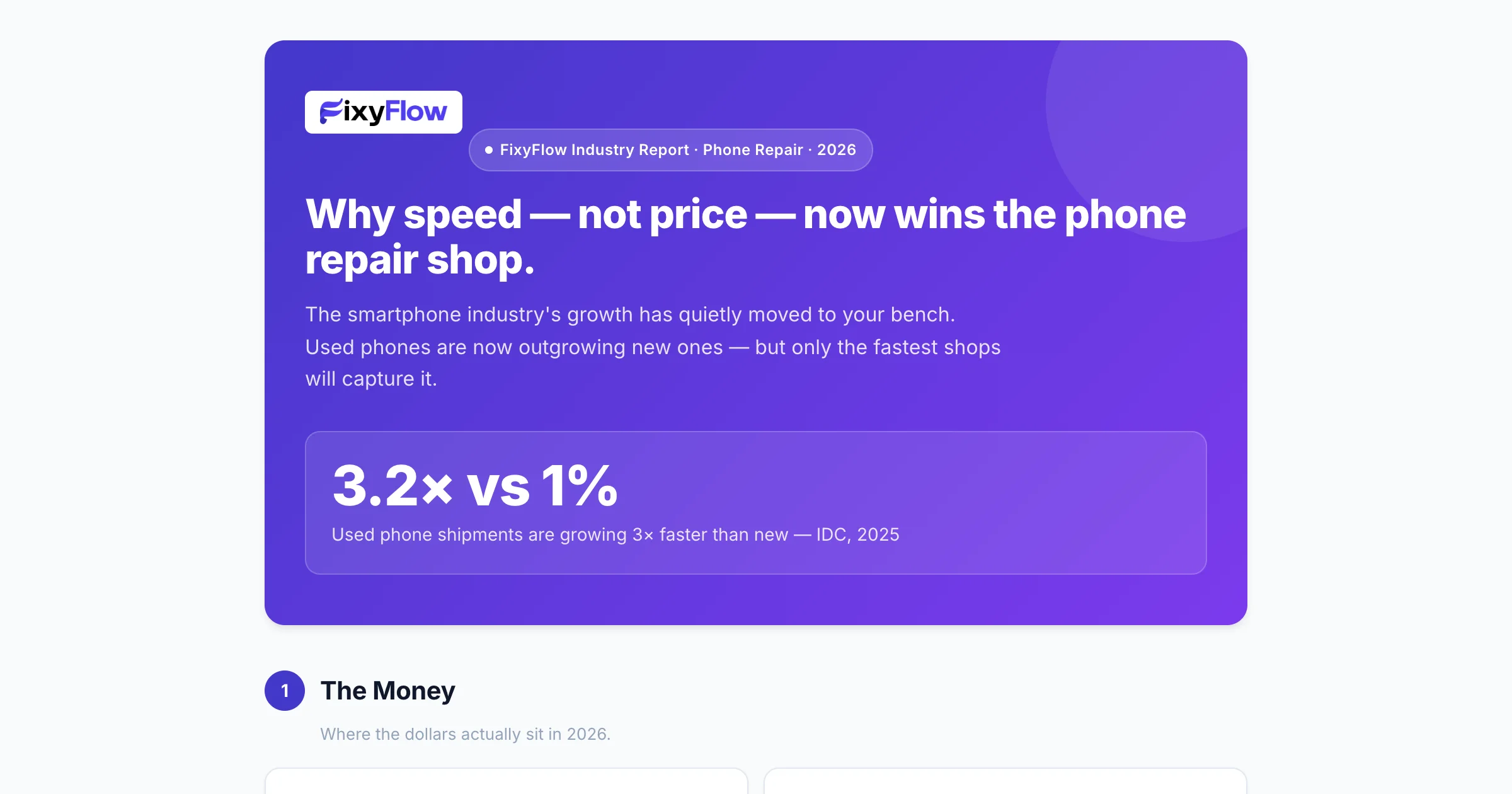
The Phone Repair Industry Has a Speed Problem, Not a Pricing Problem
The independent phone repair shop in 2026 is not losing customers to Apple, to Best Buy, or to mail-in services. It is losing them to the shop down the street that finishes the job inside 24 hours and texts the customer when it is ready. Pricing power has been compressed by right-to-repair legislation in seven US states, and that compression is permanent. What has not been compressed - and what most operators are still under-investing in - is turnaround time and customer communication.
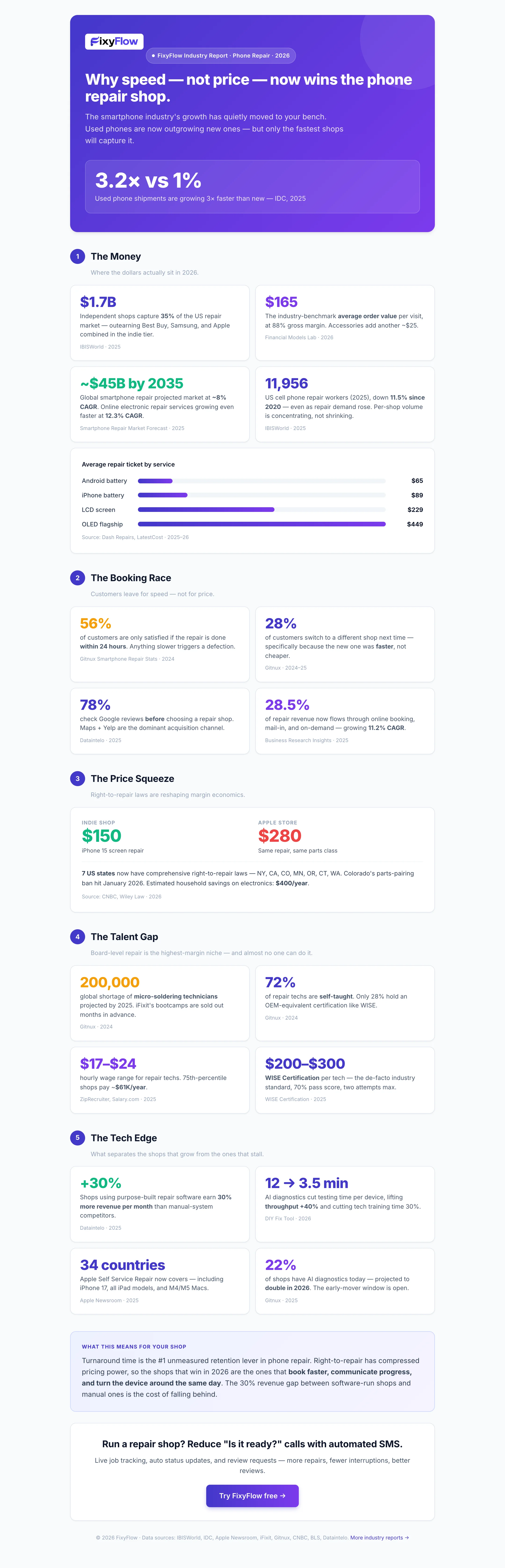
Is the phone repair market actually shrinking in 2026?
The headline is misleading. The US cell phone repair market sits at $4.2B in 2025, growing at roughly 1.3% per year (IBISWorld, 2025), and the BLS data underlines that - the US headcount for cell phone repair workers sat at 11,956 in 2025, down 11.5% from 2020. On its face, this looks like an industry in slow decline.
It is not. The global smartphone repair market is projected to reach roughly $45B by 2035 at an 8% CAGR, and the online channel inside that (mail-in, on-demand dispatch, app-based booking) is growing at 12.3%. Independent shops captured 35% of the US repair market in 2023, worth $1.7B - more than Best Buy and Samsung combined in the indie tier. The number of shops is shrinking, but the volume per surviving shop is rising. And while domain-level demand looks flat, the second-hand smartphone market is growing 3.2% year-over-year in 2025 versus only 1% for new phones (IDC, 2025).
The takeaway is operational, not strategic. The market is concentrating. The shops that survive the next three years will be capturing larger volume from fewer competitors - which is the same dynamic I covered in our breakdown of phone repair shop efficiency benchmarks.
Why do customers really switch phone repair shops?
Two numbers from the Gitnux industry data should reframe how an operator thinks about retention. The first is that 56% of customers are only satisfied if their repair is done within 24 hours. The second is that 28% of customers who switch repair shops next time do so specifically because the new shop was faster - not because it was cheaper.
Most marketing in independent phone repair leans on price (best deals, lowest prices in town, beat-our-quote-by-10%). The data suggests that price is not the primary defection lever. Speed is. And speed is something every shop owner has direct control over, even when they cannot control parts cost. The same logic applies to the turnaround-time playbook we wrote up here, where the biggest gains come from workflow visibility, not from hiring faster technicians.
The second-order effect is that customer communication compounds the speed signal. A 24-hour repair feels longer if the customer has to call to check on it. A 4-hour repair feels almost instant if the customer gets a text when it is done. The 78% of customers who check Google reviews before walking in (Dataintelo, 2025) are largely reading complaints about communication, not about repair quality. That is fixable, and it is the cheapest competitive moat available to a 2-5 tech shop - which is why we built the automatic SMS update system as the first feature of FixyFlow.
How are right-to-repair laws changing phone repair pricing?
Seven US states (NY, CA, CO, MN, OR, CT, WA) now have comprehensive right-to-repair laws, and Colorado's parts-pairing ban took effect in January 2026. CNBC put the average household savings on electronics repair at roughly $400 per year. The independent-shop price for an iPhone 15 screen is now around $150, against $280 at Apple - a 46% gap.

This is structurally good for indies and structurally bad for OEMs, but it is also a pricing trap for any indie who decides to compete on margin alone. If the indie shop's only differentiation is price-versus-Apple, the gap eventually compresses (Apple has been adjusting in response, and the recent expansion of Apple Self Service Repair to 34 countries is part of that response), and the indie has nothing left to defend.
The shops that will defend their margin through the next 2-3 years are the ones that pair the price advantage with same-day service and proactive communication - so when the price gap narrows, the customer stays for reasons that are not just dollars. Our repair shop pricing guide goes deeper on which services to defend and which to let compress.
How bad is the phone repair technician shortage?
Roughly 72% of repair technicians are self-taught (Gitnux, 2024), and the global shortage of micro-soldering technicians is projected to hit 200,000 by 2025. iFixit's board-repair bootcamps have been selling out months in advance. WISE certification - the de facto industry standard - runs $200-$300 per tech with a 70% pass rate. Hourly wages sit in the $17-$24 range, with the 75th percentile around $61K per year.
The talent gap is real, and it is widening. But for the indie shop with 1-5 techs, the gap is not necessarily the constraint - turnaround per tech is. AI diagnostic tools have cut testing time from roughly 12 minutes per device to 3.5 minutes, lifting throughput by about 40%. That means a 2-tech shop with diagnostic software is producing the output of a 3-tech shop without it, while paying two salaries instead of three.
This is why the often-cited “shops using purpose-built repair software earn 30% more revenue per month” stat (Dataintelo, 2025) is not just a marketing claim. The math compounds: faster diagnostics raise throughput, throughput raises capacity, capacity raises average revenue per tech, and the freed-up minutes get reinvested in customer communication - which raises retention.
What should phone repair shop owners focus on in 2026?
If I owned a 2-5 tech shop in the US or Canada in 2026, I would worry less about pricing positioning and more about three operational metrics. First, percentage of repairs completed inside 24 hours - measured weekly, posted in the back. Second, percentage of customers who receive an automatic SMS update at intake, in-progress, and complete - target 100%, not 80%. Third, monthly review velocity from completed jobs - because reviews are the acquisition flywheel for the 78% of customers who check before walking in (we wrote up the review-ask scripts here).
Right-to-repair is already done. Pricing will not get easier. But same-day repair plus proactive communication is the cheapest competitive moat an indie shop can build in 2026, and it does not require hiring a micro-soldering specialist or buying an AI diagnostic system that costs more than the shop's monthly rent. It requires the basic workflow tooling that 30% of the industry still does not have. If you are still tracking jobs on paper or in a spreadsheet, the 30% revenue gap between software-run shops and manual ones is the cost of waiting - and the consolidation window is closing as franchise chains and roll-ups buy up independents.
Reduce “Is it ready?” calls with automated SMS.
Live job tracking, auto status updates, and review requests built for 2-10 tech repair shops. Free tier, no credit card.
Try FixyFlow free →Sources: IBISWorld 2025, IDC 2025, Gitnux 2024-25, CNBC 2026, Wiley Law 2026, Apple Newsroom 2025, iFixit Repair Academy 2025, DIY Fix Tool 2026, Dataintelo 2025, BLS 2025. — Lasse / Built FixyFlow in Collingwood