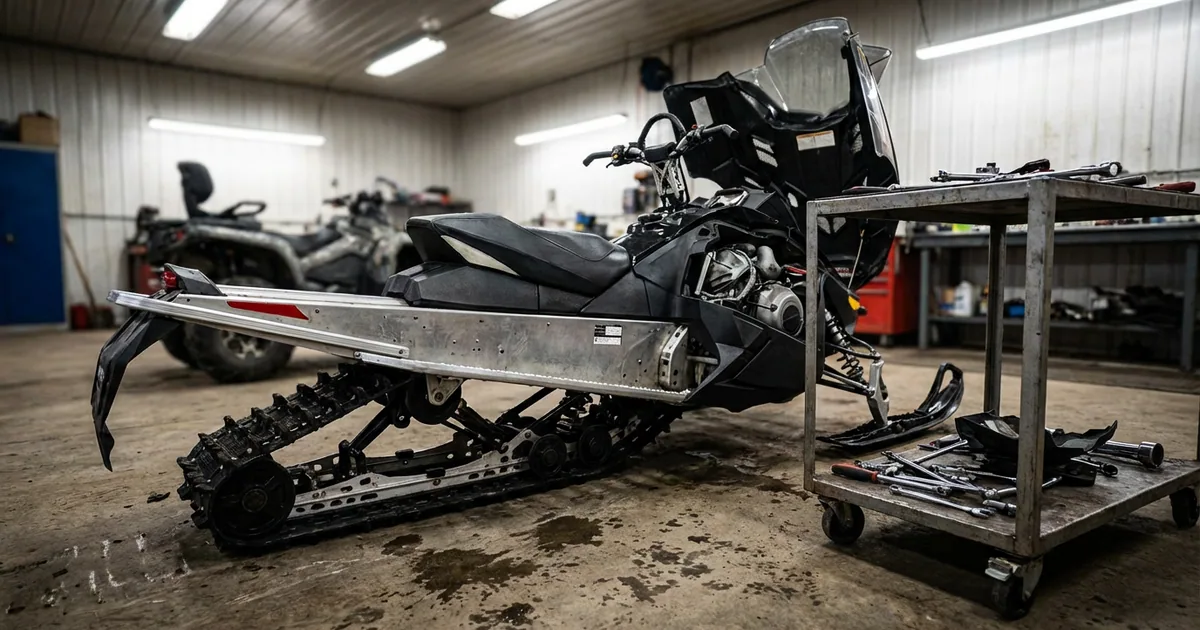
Snowmobile and ATV Repair Tracking: A Canadian Shop Guide
If you run a snowmobile or ATV repair shop in Canada, your business is defined by seasons. October through December, sleds flood in for pre-season service. January through March, you're handling breakdowns, warranty work, and trail-damaged machines. April through June, ATVs and side-by-sides take over. July through September, you're catching up on the backlog, doing off-season rebuilds, and prepping for the next wave.
Through all of this, you're managing customers who want their machines back yesterday, sourcing parts from Ski-Doo, Polaris, Arctic Cat, and Can-Am distributors who don't always move fast, and trying to run a profitable business in a market where your customers are spread across a 200-kilometre radius.
This guide covers how to manage that reality — from seasonal workflow planning to customer communication, parts delay management, pricing, and getting Google reviews in markets where word of mouth has traditionally been the only marketing that matters.
What's the powersports repair opportunity in Canada?
Canada has over 600,000 registered snowmobiles and over 1 million registered ATVs and side-by-sides. Ontario alone accounts for roughly 300,000 registered snowmobiles, concentrated in corridors like Barrie–Orillia, Parry Sound–Muskoka, Sudbury–North Bay, Sault Ste. Marie, and the Ottawa Valley.
The average snowmobile owner spends $500–$1,500 per year on maintenance and repairs. For ATVs and side-by-sides, the figure is similar. That means a shop servicing 200 regular customers is looking at $100,000–$300,000 in annual service revenue before you even count major rebuilds, accessory installs, or parts sales.
But here's the challenge: most powersports shops are small operations. One or two techs, a shop attached to a house or a rented bay, and a customer base that expects dealership-level communication from a business that's running on spreadsheets and sticky notes.
The shops that grow beyond that ceiling are the ones that systematize their customer communication. Not because they have bigger budgets, but because they stop losing customers to silence, missed callbacks, and forgotten follow-ups.
Pre-season vs in-season: how should your workflow shift?
Powersports repair has two fundamentally different modes, and your communication strategy needs to match each one.
Pre-season service (October–December for snowmobiles, April–June for ATVs)
Pre-season is high-volume, low-complexity work: oil changes, belt inspections, coolant flushes, track tension, carbide and runner replacement, clutch service. You might have 40–60 machines queued up at once, with customers expecting them back before the first good snow or the May long weekend.
The communication challenges during pre-season:
- Volume. You cannot call 50 customers individually to give status updates. You don't have the time. This is where automated text updates become essential — one tap to move a job to "In Service," another tap to "Ready for Pickup," and the customer gets notified both times without you touching a phone.
- Queue management. Customers want to know where they are in line. "We received your sled on October 15th, we have 12 machines ahead of you, estimated service start is the week of November 1st" is infinitely better than "we'll get to it."
- Upselling discovered issues. During pre-season service, you often find problems the customer didn't know about: a worn track, a leaking shock, corroded wiring. Getting fast approval to add work to the ticket is the difference between a $200 service and an $800 service — and between a satisfied customer whose sled runs perfectly all winter and one who breaks down on the trail in January.
Text-based approval (instead of phone tag) is critical here. Send a text: "Found a worn track driver during inspection. Recommend replacing before the season — $340 parts + labour. OK to add to the job? Reply YES or call us." Average response time: 12 minutes. Average response time via voicemail: 26 hours. That difference, multiplied across 50 pre-season jobs, is the difference between finishing before snow flies and being backed up until Christmas.
In-season breakdown repairs (January–March for snowmobiles, June–September for ATVs)
In-season work is the opposite: lower volume, higher urgency, higher emotional stakes. Someone's sled broke down on the trail near Parry Sound. They trailered it to your shop. They have a group ride planned for next weekend. They need it fixed now.
In-season communication rules:
- Speed of first response matters most. Within 1 hour of receiving the machine, send a text: "Got your [machine]. We'll diagnose it today and text you what we find." That single text buys you 24 hours of goodwill.
- Be honest about timelines. If the repair needs a part that takes a week, say so immediately. Don't give a vague "couple of days" and hope for the best.
- Offer alternatives when possible. "The OEM clutch kit is 2 weeks out, but we can get an aftermarket kit in 3 days for $50 less. Want to go that route?" Giving the customer a choice respects their time and their wallet.
Customer communication for multi-week repairs
Some powersports repairs take weeks. Engine rebuilds, electrical gremlins, frame damage, insurance jobs. For these, silence is the enemy.
The weekly update rule
For any job lasting more than 7 days, send a proactive update every week. Friday afternoons work well — the customer heads into the weekend knowing what's happening with their machine.
[Shop name]: Weekly update on your [year/make/model]. Completed: engine teardown and inspection. Found: worn piston rings and scored cylinder wall. Next step: cylinder re-bore (sent out Tuesday, back in ~5 days). Estimated completion: [date]. Questions? Reply here.This one text prevents 3–5 phone calls the following week. It's 30 seconds to type. It saves you 20–30 minutes in avoided calls and interruptions.
The milestone notification
For major rebuilds, add milestone texts beyond the weekly cadence:
- "Engine is out and on the stand. Starting teardown today."
- "All parts are in. Starting reassembly tomorrow."
- "Engine is back in the chassis. Running first start-up tests."
- "Your [machine] is done and ready for pickup!"
Each milestone builds excitement and trust. By the time the customer picks up, they feel like they were part of the process. That emotional connection drives reviews, referrals, and loyalty.
Parts sourcing and delay management
Powersports parts availability is unpredictable. Manufacturer supply chains, cross-border shipping, and seasonal demand spikes all create delays that aren't your fault — but become your problem.
Common parts timelines
- Belts, filters, plugs, fluids: Same-day if you stock them. 2–3 days from a Canadian distributor.
- Clutch components, track studs, suspension parts: 3–7 business days from major distributors (Kimpex, Parts Canada, Western Power Sports).
- Engine internals, cylinder kits, crankshafts: 1–3 weeks from OEM. Aftermarket options (Wossner, Wiseco) sometimes faster.
- Electrical components, ECUs, wiring harnesses: 1–4 weeks from OEM. Very limited aftermarket availability.
- Legacy parts (pre-2010 machines): Highly variable. May require salvage sourcing, which can take weeks.
The parts delay communication protocol
When a parts delay happens (and it will), follow this protocol:
- Day of discovery: Text the customer immediately. "The [part] for your [machine] is delayed. New ETA: [date]. This pushes completion to approximately [date]. We're checking other sources."
- If you find an alternative: Text the option. "Found an aftermarket [part] that ships in 2 days instead of 2 weeks. Same quality, $30 cheaper. Want to go with it?"
- If the delay extends again: Update immediately with the new timeline. Never let a customer learn about a delay by calling you to ask.
This protocol takes 2 minutes per incident and eliminates the frustration that causes bad reviews. Customers in Barrie, Orillia, Sudbury, and across northern Ontario understand that parts take time. What they don't accept is finding out a week late.
Building trust with status updates
In rural and small-town markets, trust is everything. Your customer base isn't anonymous internet shoppers — they're members of your community, your snowmobile club, your kid's hockey league. One bad experience travels fast. One great experience travels faster.
Status updates build trust because they demonstrate three things:
- You're organized. A shop that sends structured updates looks professional. A shop that you have to chase for information looks chaotic.
- You respect their time. Every proactive update saves the customer a phone call they didn't want to make. They notice.
- You're transparent. Updates about delays and problems (not just good news) show integrity. The customer thinks: "If they tell me the bad stuff up front, I can trust the good stuff."
Setting up a proper job tracking system with automated customer notifications is the fastest path to building this trust at scale. Every job gets a tracking link. Every status change triggers a text. The customer checks their link instead of calling you. You keep working.
For mobile service businesses that go to the customer's location, this is even more important — the customer can't just "pop in" to check on progress.
How should you price powersports repairs?
Pricing transparency is a communication tool. Customers who understand your pricing trust you more and complain less.
Labour rate benchmarks (2026, Ontario)
- Independent shops: $90–$130/hour
- Dealerships: $130–$170/hour
- Specialty builders (performance sleds, race prep): $150–$200/hour
Common job pricing
- Pre-season service (snowmobile): $250–$500 depending on scope
- Belt replacement (snowmobile): $150–$250 parts and labour
- Track replacement: $600–$1,200 parts and labour
- Top-end rebuild (2-stroke): $800–$1,500
- Full engine rebuild: $2,000–$4,000+
- ATV/UTV annual service: $200–$400
- ATV winch install: $300–$600 parts and labour
Publish your common service prices on your website and in your shop. When a customer can see that a pre-season service is $350 before they drop off, there are no surprises at pickup. Transparency builds trust. Surprises destroy it. For a deeper look at service pricing strategy, see our repair shop pricing guide.
How do you get Google reviews in rural markets?
In a city like Toronto, a business might need 100+ Google reviews to stand out. In Parry Sound, Bracebridge, Orillia, or Elliot Lake, 15–20 reviews makes you the most-reviewed shop in the area. The bar is low. The impact is massive.
Why rural reviews matter more per review
- Less competition. If your three competitors have 2, 5, and 8 reviews respectively, and you have 20, Google ranks you first for "snowmobile repair [town name]" every time.
- Higher trust per review. In a small community, people recognize the names in the reviews. "Oh, Mike from the snowmobile club uses them? They must be good."
- Wider search radius. A customer in Huntsville searching for "ATV repair near me" might see results from Bracebridge, Gravenhurst, and Parry Sound. In a sparse market, your reviews pull customers from further away.
How to ask for reviews without being awkward
In small towns, the review ask can feel uncomfortable because you know the customer personally. Here's how to make it natural:
- Automate it. Set up an automatic text that sends 2–4 hours after you mark a job as picked up: "Thanks for choosing [shop name] for your [machine]! If you're happy with the work, a quick Google review would really help us out: [link]. Cheers!"
- Time it to emotional highs. After a pre-season tune-up (customer is excited for the season) or after an in-season breakdown fix (customer is relieved) — these are the moments when people gladly leave reviews.
- Make it one tap. Use a direct Google review link so they tap once and the review form opens. Every extra step cuts your conversion rate in half.
Over a pre-season rush of 40–50 machines, this automated approach can generate 10–15 reviews without you saying a word in person. That alone can transform your Google presence in a rural market.
Building a system that runs year-round
The smartest powersports shops use the off-season to build the systems that make the busy season manageable.
Summer (for snowmobile-focused shops)
- Set up your job tracking tool and define your workflow stages
- Import your customer contact list from last season
- Create text templates for each stage: received, diagnosing, parts on order, in repair, ready
- Build your Google review link and test the automated review request
September
- Send a pre-season outreach text to last year's customers: "Pre-season bookings are open. First 20 get priority scheduling. Reply to book."
- This single text can fill your October–November schedule before the season even starts
October–December
- Run the system. Every machine gets a tracking link. Every status change triggers a text. Approvals happen via text. Review requests go out at pickup.
- You focus on turning wrenches. The communication runs itself.
January–March
- In-season breakdown repairs get the same automated treatment: intake confirmation, diagnosis notification, parts updates, completion text.
- Speed of first response is your competitive advantage. The shop that texts "Got your sled, diagnosing today" within an hour wins the customer for life.
April–June
- ATV and side-by-side season. Same workflow, same stages, same automated updates.
- Send pre-season outreach to your ATV customer list in March.
Start this week
You don't need to overhaul everything at once. Pick one thing:
- If status calls are killing your productivity: Set up FixyFlow and create your first job with a real customer. Move it through the stages and watch the automatic texts go out. Most shops see an immediate drop in inbound calls.
- If parts delays are your biggest complaint source: Commit to same-day delay notifications. One text per delay. It takes 30 seconds and prevents days of customer frustration.
- If you want more Google reviews: Set up the automated review request text. Time it for 2 hours after pickup. Let it run through your next pre-season rush and watch the reviews roll in.
Powersports customers in communities like Barrie, Orillia, Parry Sound, Sudbury, Bracebridge, and across Ontario's snowbelt are loyal when they're treated well. The shop that keeps them informed, respects their time, and communicates proactively becomes their shop for life — and the shop their friends hear about at every trail stop and riding group meetup.
Build the communication system once. Let it run. Focus on what you do best: keeping machines on the trail.