
How to Start a Cleaning Business in Ontario (2026)
Most "start a cleaning business in Ontario" guides read like LinkedIn motivational posts. Register, buy a vacuum, post on Facebook, hit six figures by Q3.
The actual experience of starting a residential or commercial cleaning operation in Ontario in 2026 is more boring, more paperwork-heavy, and more financially specific than those guides admit. I have been around enough Collingwood and Georgian Bay service operators (and run my own service work locally) to know where new owners hit the wall. It is almost never the cleaning itself - it is the HST timing, the insurance gaps, the customer-acquisition math, and the point where solo stops working.
This is the version of the guide written for the operator who actually plans to stay in business 36 months from now.
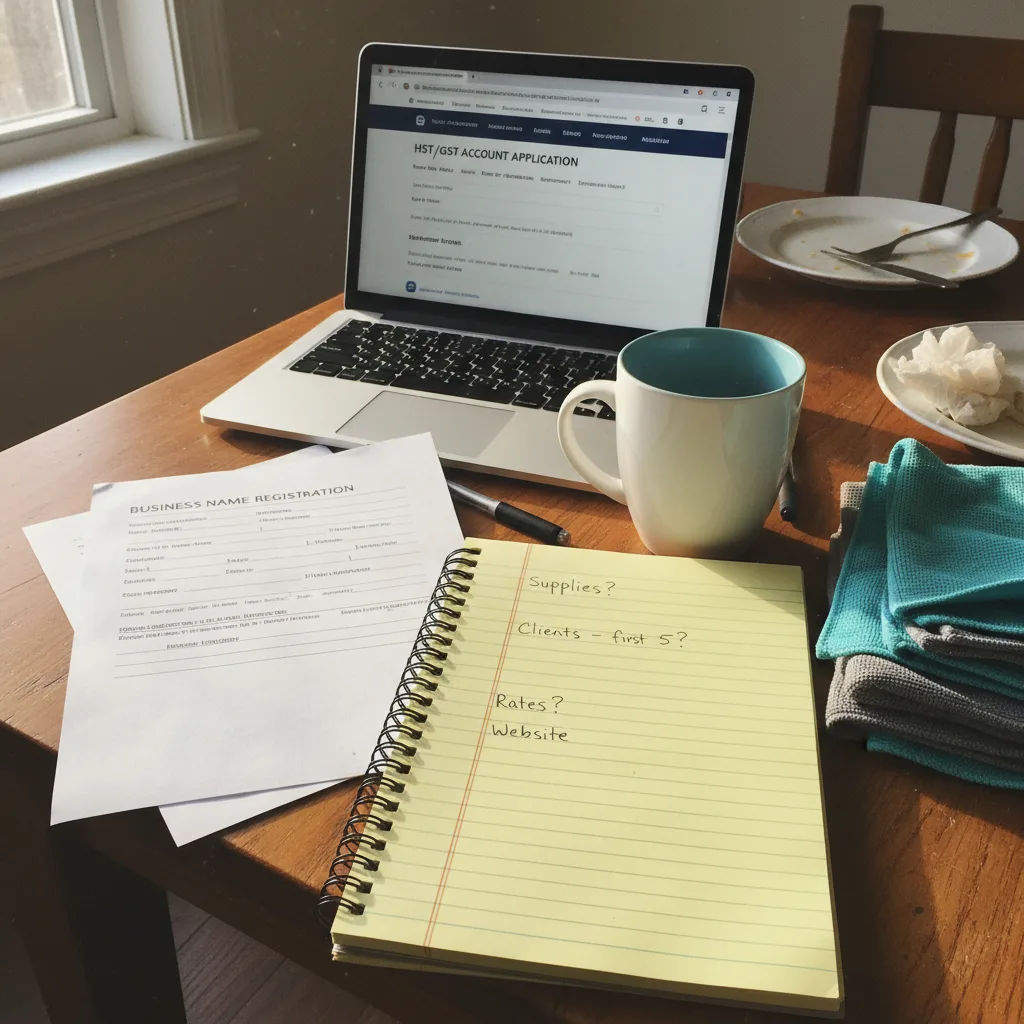
The 7-day paperwork list, in the actual order that works
Most articles list these steps in a way that mixes "do tomorrow" with "do once a year." Here is the order that saves rework:
Day 1 - Pick the legal structure.
Sole proprietorship for 95% of solo operators. Costs $60 to register the business name through the Ontario Business Registry. Federal incorporation is overkill unless you already have liability exposure or are pre-approved for a small-business loan that requires it. (You can incorporate later. The reverse - de-incorporating - is more painful.)
Day 1 - Register the business name.
Through the Ontario Business Registry. Online, takes 20 minutes. You will need a Master Business Licence number for the HST application later.
Day 2 - Open a separate business bank account.
Not the most exciting step, but doing this before your first invoice means you never co-mingle personal and business cash. Tangerine and Manulife do free business chequing for sole props. Avoid the Big 5's "Business Starter" accounts - $14-19/month for features a solo cleaner does not need.
Day 2-3 - Get general liability insurance.
$1M minimum, $2M is standard. Commercial clients (offices, medical, daycare) will require proof of insurance before they sign. Quotes from Zensurance, Apollo, or your local Ontario broker usually land at $30-50/month for a solo operator. (Bonding is a separate product - more on that below.)
Day 4-5 - Buy basic supplies and a simple intake system.
Microfibre cloths, all-purpose, glass, bathroom, vacuum, mop. Total ~$300-500 for a usable kit. The cheapest line item is actually the cleaning gear; the expensive part is your time. Pair this with an intake form so the first 5 clients give you the same data structure - this becomes important when you book them again 6 months later.
Day 6-7 - Set up booking and customer comms.
This is the one most new operators skip and regret. You are going to schedule visits, send confirmations, send "on my way" texts, ask for reviews, and eventually field rebookings. Doing all that from a personal text thread breaks at client #15. Set up a customer-tracking system early (here is the version we built for service operators) - the up-front 30 minutes saves you 5 hours/month within 90 days. And since you are texting customers in Canada, put an opt-in checkbox on your intake form from day one - the CASL texting rules put the burden of proving consent on you, and retrofitting consent records at client #100 is miserable.
You can complete all 7 steps in a calendar week. The HST application is the one you can defer.
The HST trap: when to register early, when to wait
The standard advice is "register for HST once you cross $30,000 in revenue." That is technically the legal requirement. It is also the source of one of the most expensive mistakes new cleaning operators make.
Here is the math.
If you register voluntarily before hitting $30K, you collect 13% HST from your customers and remit it to the CRA quarterly - but you also reclaim Input Tax Credits (ITCs) on every business expense. For a solo cleaner spending $4,000/year on supplies, mileage, insurance, and tools, that is roughly $520 in HST you would otherwise eat as a cost if unregistered.
The countervailing argument: residential cleaning customers are paying out of pocket, do not get to claim the HST back, and will see your prices as 13% higher than your unregistered competitors.
The actual decision:
- Commercial-cleaning focus (offices, Airbnbs, contractors): register on day 1. Your customers do claim it back, your prices look identical, and you get ITCs from day 1.
- Residential-cleaning focus: stay unregistered until you cross $30K, then register the next quarter. The 13% optics matter more in residential.
- Hybrid: do the math on your specific expense load. Usually flips in favour of early registration around $15K/year in expenses.
HST registration is free through the CRA. Filing is quarterly for most new operators, annually if you ask CRA to elect annual filing under $1.5M in revenue. Annual filing reduces paperwork by ~75% but parks the money in your account longer, which can be a cash-flow trap if you spend it.
Insurance: what each policy actually covers (and which one you can probably skip)
There are 4 insurance products cleaning businesses get pitched. Most operators need 2, sometimes 3.
| Insurance | What it covers | Solo operator? |
|---|---|---|
| General Liability (GL) | A customer trips on your wet floor, a client's property gets damaged | Required. $1M-$2M, ~$30-50/month |
| Bonding | Theft by an employee | Skip if solo. Required only if hiring and only some commercial clients ask |
| Tools & Equipment | Your equipment is stolen from your car | Recommended if you have over $1,500 in supplies/tools - usually $10-15/month add-on |
| WSIB | Worker injury - own injury or employee injury | Required if hiring. Optional for sole props (see below) |
WSIB is the one most operators get wrong. As a sole proprietor with no employees, WSIB is optional. Many cleaners skip it entirely (the WSIB rules for solo operators explain when optional coverage is still worth buying). But the moment you hire your first employee or independent contractor, you have 10 calendar days to register. The penalty for missing this is steep and tied to back-coverage of that worker, so set a calendar reminder.
If you are doing residential cleaning solo, full-coverage GL plus tools and equipment is the right baseline. Hold off on bonding until your first commercial client explicitly asks - it is sometimes faster to get a one-off binding certificate for a specific contract than to carry annual bonding.
Customer acquisition: the math nobody shows you
Every guide says "advertise on Facebook, get referrals." That is not a plan, that is a wish.
Here is the spend-vs-result math from real Ontario solo operators in 2025-2026:
- Door hangers / lawn signs in a target neighbourhood: $0.30-0.50 per impression, ~0.5-1% response rate. So $200 in materials placed on 400-600 doors yields 2-6 first-call leads.
- Google Business Profile (free) with weekly photo posts: usually delivers 1-3 leads/week after 60-90 days, much faster than people expect once you collect 10+ reviews.
- Facebook local-buy-sell groups with a friendly intro post (not a sales post): 2-5 inquiries per post, but groups have rules - know them before you post.
- Neighbourhood referrals: highest conversion rate (~50%+) but lowest volume in month 1.
- Paid Facebook Ads: avoid for the first 90 days. Cleaning is a trust purchase, and a stranger-to-customer ad rarely beats a referral. Most new operators burn $400-600 here before realizing it.
The number to remember: your break-even cleaning visit count for the first year is usually around 12-18 recurring residential customers OR 4-6 commercial accounts. That is your real target for "I have a business now," not the $30K HST threshold and not "5 clients."
When solo stops working (and what changes)
Most Ontario solo cleaners hit a wall at one of two points:
- The schedule wall - around 25 hours/week of cleaning time, you are physically capable but unable to take new clients without firing existing ones. (Your visit length per client is harder to compress than you think.)
- The driving wall - if your service area is more than ~20km radius, you are spending more time in the truck than cleaning. The math fails around 6-8 customers/day.
Both walls hit before $60-70K in revenue for most solo operators. The decision at that point is hire vs. specialize:
- Hire an employee - real W2 employee, T4 slip, CPP and EI deductions, WSIB premiums. Cleaner labour in Ontario in 2026 is ~$18-22/hour to attract reliable. Build payroll into your pricing now or you will eat the spread.
- Hire a contractor (1099 equivalent) - tempting, often miscategorized. CRA has been auditing service-business contractor relationships heavily since 2023. If the cleaner uses your supplies, on your schedule, in your branded shirt - that is an employee, full stop. Calling them a contractor to skip payroll deductions is the most common mistake in this space, and the catch-up bill is brutal.
- Specialize and stay solo - higher-ticket niches: post-construction, move-out, Airbnb turnovers in cottage country. Charge $80-150/visit instead of $40-60, do fewer visits.
Most of the operators I have seen do well in Collingwood and Georgian Bay pick the third option for at least the first 24 months. Solo-but-specialized beats "scaled but underwater" every time.
The tools you will actually need at month 1 vs month 6
Month 1: a kit, a phone, a calendar, a bank account, an intake form. That is it.
Month 6 - when you have 8-15 recurring customers - what breaks is not the cleaning. It is the customer communication. You will be:
- confirming visits the day before
- sending "on my way" texts
- chasing customers for the next month's booking
- following up after one-off jobs for reviews
- handling reschedules during weather events or kid sick days
This is when most operators either build a janky Google Sheet + Calendar setup, pay $79/month for Jobber or HouseCallPro that has way more features than they need, or come find something like FixyFlow built for exactly this size of operator. The choice is yours - but plan for this transition around month 6, not when you are already drowning at month 9.
If you want to see what the customer-side experience looks like for a cleaning business specifically, the demo page is here. Real before/after photos, real status timeline, the kind of experience that gets reviews left without having to ask.
What I would do differently
Three things, if I were starting fresh in Ontario in May 2026:
- Register the business name and HST early, not late. The $30K threshold is a tax compliance number, not a business strategy. If you are confident you will cross it in year 1, register on day 1 and reclaim ITCs from your first dollar.
- Pick a sub-niche by week 6. Move-out, post-construction, Airbnb turnover, dental/medical offices - any sub-niche beats "we clean everything." Marketing becomes 5x easier.
- Build the customer-comms layer before you need it. The operators who scale past solo are the ones who do not panic-shop for software at month 9. Set up SMS confirmations, reminders, and review requests in week 1 and the rest of the operation runs cleaner from there.
The boring paperwork part is solved in 7 days. The customer side is the work for the next 36 months.
— Lasse
Built FixyFlow in Collingwood