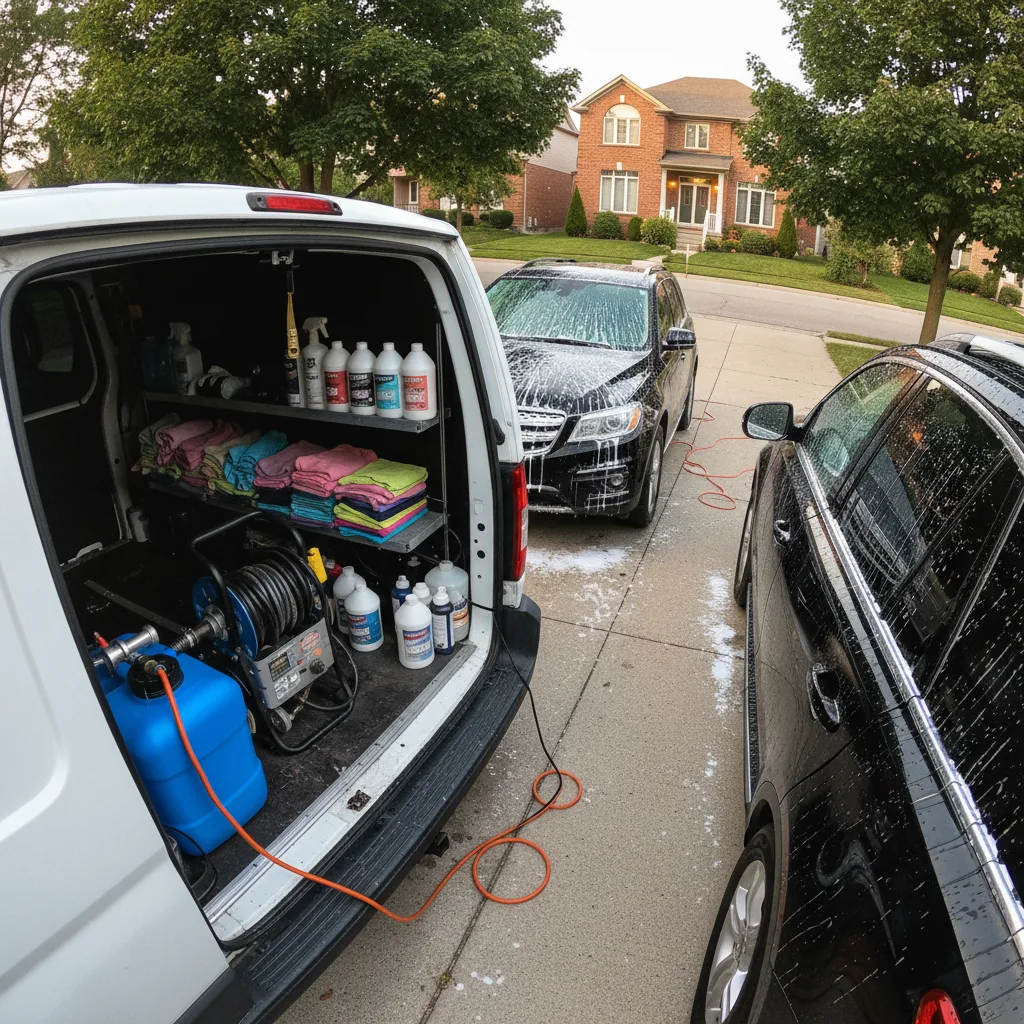
How to Start a Mobile Detailing Business in 2026 (Canada Edition)
Every "start a mobile detailing business" guide on the internet in 2026 reads the same. Buy a pressure washer. Pick a name. Make a logo. Post on Facebook. Three weeks later you are wondering why nobody is calling, the inside of your van smells like wet microfiber, and your first customer cancelled because you said you would arrive at 9 and rolled in at 10:15 with a dead phone.
This is the version of the guide that says the boring true things first. Real numbers, real logistics, and the parts most articles skip - like what you actually do when the customer's outdoor tap is locked, why nobody warned you about the November-to-March revenue cliff in Ontario, and the fact that you will spend more time texting customers your ETA than you will polishing paint.
I have spent the last two years watching mobile detailers in Collingwood, Barrie, and the GTA either build something durable or quit by month nine. The pattern is the same every time, and almost none of it is about the detailing.
Is mobile detailing actually a viable business to start in 2026?
Yes, for the right operator, in the right market. Mobile detailing is one of the cheapest service businesses to start in Canada - real startup cost is $3,500-$8,000 depending on whether you buy used equipment - and demand is steady year-round in interior work even when exterior work freezes in winter. The catch: it is also one of the easiest businesses to start, which means the local market is saturated with operators who undercharge and disappear in 18 months. Pricing discipline and customer-comms reliability are what separate the durable ones from the churn.
The mobile detailing market in Canada has roughly tripled in operator count since 2019. Some of that is genuine demand (people are keeping cars longer, ceramic coating and PPF are now mainstream, and dealer pre-owned reconditioning is being outsourced more). Some of it is the YouTube effect - lots of new operators starting after watching a few channels, then cutting prices to win local jobs.
What it means for you: there is room for an operator who shows up on time, charges fairly, and communicates well. There is no room for the 23rd $80 interior detail in your town. Position around reliability and visible quality from the start, not low price.
How much does it actually cost to start a mobile detailing business?
Realistic startup cost is $3,500-$8,000 for a viable solo mobile detailing setup in Canada - including a used vehicle outfit, pressure washer, vacuum, polisher, and consumables for 90 days. Anyone telling you it is "under $1,000" either already owns half the equipment or is selling you a coaching program.
Here is the honest equipment breakdown for a Canadian solo operator starting cold:
| Item | Realistic CAD cost | Notes |
|---|---|---|
| Used cargo van or pickup with cap | $2,000-$15,000+ | Most start with the family vehicle - upgrade once revenue justifies |
| Pressure washer (2,500-3,200 PSI gas) | $400-$900 | Gas, not electric. Customer hoses + electric units are unreliable |
| Foam cannon | $60-$150 | Skip the $20 Amazon ones, they clog inside 30 days |
| Wet/dry vacuum (commercial) | $200-$500 | Shop-Vac Pro or equivalent - household vacs die in 6 months |
| Dual-action polisher + pads | $300-$600 | Rupes, Griot's, or Maxshine - skip Harbor Freight here |
| Microfibers, towels, brushes, applicators | $300-$500 | Colour-coded bins prevent cross-contamination |
| Soaps, polishes, compounds, ceramic spray | $400-$800 | 90 days of consumables to start |
| Portable water tank (25-50 gallon) | $200-$500 | Skip if you only work driveways with outdoor taps |
| Portable inverter generator (2000W) | $500-$1,200 | For condo lots and commercial gigs without outlets |
| Insurance (annual) | $700-$1,500 | General liability + tools coverage - see section below |
| Business registration + GST/HST setup | $60-$200 | Sole prop is fine to start in most provinces |
Total at the low end - using a vehicle you already own and buying used equipment off Marketplace - is around $3,500. At the high end, with a $10,000 dedicated van, you are at $12,000-$15,000. Most reasonable starts come in around $5,000-$7,000.
One number that surprises new operators: 90 days of consumables. That box of microfibers and the half-gallon of polishing compound look cheap until you do five details a week. Plan for a $400-$600 monthly consumables run by month 2.
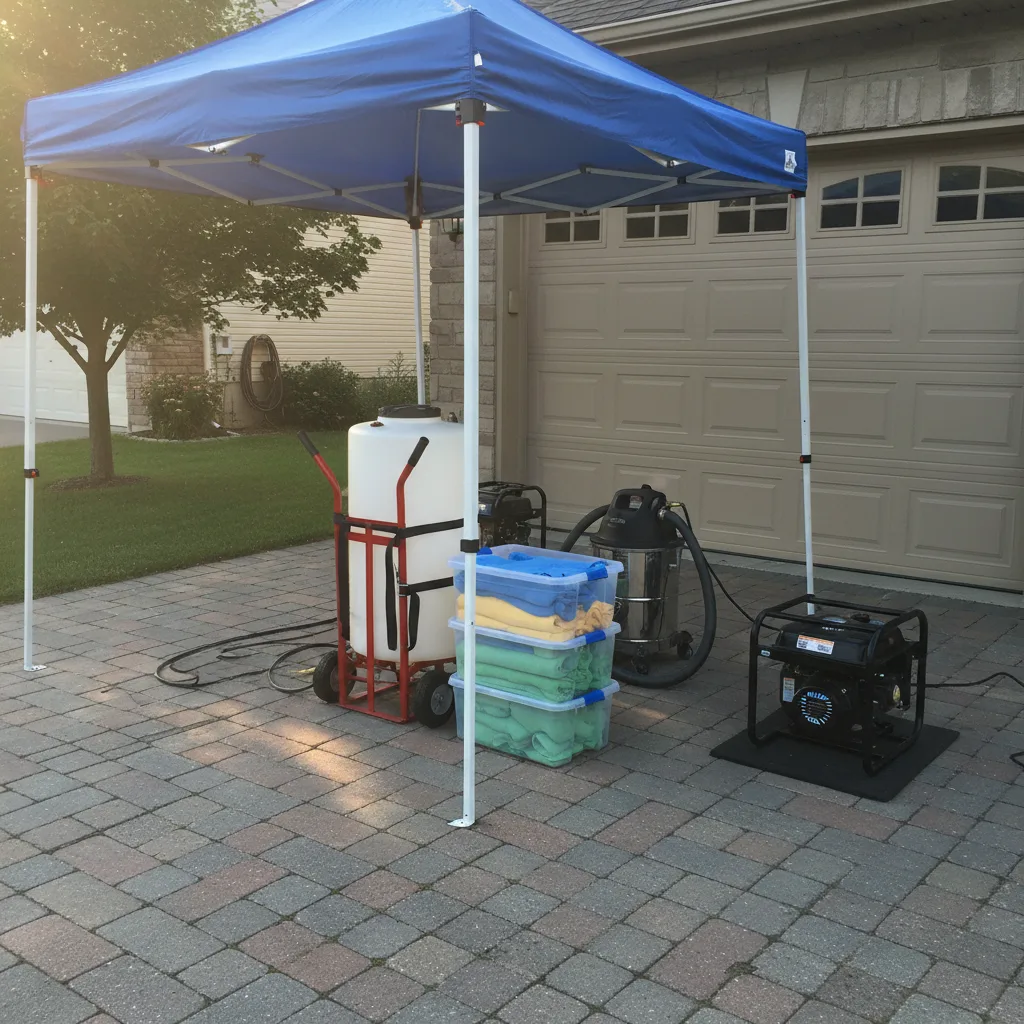
Do I need my own water tank and generator, or can I use the customer's hose?
Most new mobile detailers can start using customer water and power for residential driveway jobs. A portable tank and generator matter for condo lots, commercial accounts, and winter prep work in heated garages - but those are 30-day-out problems, not week-one problems. Buying a tank and generator on day one is one of the most common money-wasted decisions in this trade.
Reality of working off a customer hose: about 75% of residential outdoor taps work fine. The other 25% are seized, locked, frozen for half the year, or buried behind landscaping. You will find this out the hard way. The fix is not always "buy a tank" - it is sometimes "ask the customer 24 hours before the appointment if their outdoor tap is accessible." A reminder text the day before solves more water-access problems than $400 worth of tank does.
Where the tank earns its keep:
- Condo and apartment lots - no outdoor tap, sometimes no electrical outlet either
- Commercial accounts - office parks rarely have accessible water
- Winter work in Ontario - November to March, the customer's outdoor tap is shut off at the basement; you cannot ask them to turn it on for a $120 wash
- Fleet detailing - if you grow into car-lot reconditioning, the dealer will not run hoses for you
For the first 60-90 days, work the jobs you can serve from a customer hose. Add the tank when you have routed yourself into a corner that genuinely needs it. Buy used off Marketplace - they hold up fine.
The generator question is identical. Most residential jobs have an outdoor outlet. Condo jobs do not. Buy the generator the week you book your first condo job, not before.
What insurance does a mobile detailer in Canada actually need?
Three things are non-negotiable: general liability ($1M-$2M coverage), commercial vehicle endorsement on your auto policy, and tools-and-equipment coverage. Plan for $700-$1,500/year in total premiums for a Canadian solo operator. Skipping any of these is how mobile detailers go bankrupt over a $30,000 paint correction job that goes sideways.
Specifics:
- General liability ($1M minimum, $2M preferred): $500-$900/year. Covers damage you cause to a customer's vehicle, property damage to their driveway or garage, and a customer slipping on a wet surface. The $400/year difference between $1M and $2M is worth paying once you start touching $50K+ vehicles.
- Commercial vehicle endorsement: $200-$600/year depending on existing premium. Your personal auto policy explicitly excludes business use - if you crash on the way to a job, a personal-only policy may refuse the claim and cancel your insurance going forward.
- Tools and equipment coverage: $10-$25/month, usually as a rider on the liability policy. Replaces tools stolen out of the van overnight or damaged on a job site. Worth it once you have $2,000+ in gear in the vehicle.
- Workers' comp (WSIB in Ontario): Required once you hire your first employee. Not needed as a solo operator in most provinces, though some provinces let solo operators opt in voluntarily.
Get quotes from Zensurance and Apollo Insurance - both specialize in small service businesses and quote online in 10 minutes. Compare against a local broker if you have one you trust, but the online specialty insurers tend to come in 20-30% cheaper for mobile detailing specifically.
How should I price a mobile detail in Canada?
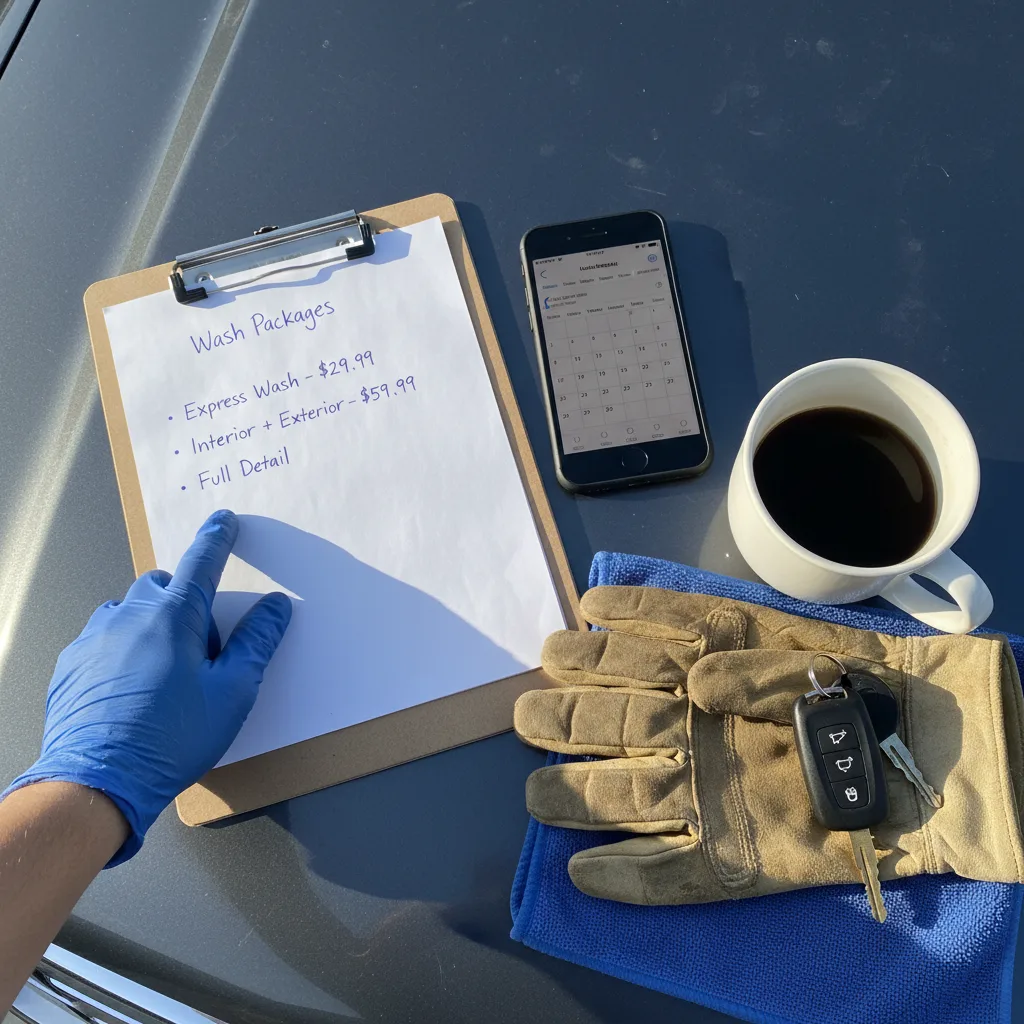
Build three packages, price the middle one at $250-$350, and never lead with the cheapest. Pricing too low is the single most common reason new mobile detailers burn out - it locks you into a customer base that will leave the second a competitor charges $20 less, and it makes the per-hour math impossible to recover from.
A workable Canadian package structure in 2026:
| Package | Time | Sedan price (CAD) | SUV/truck price (CAD) |
|---|---|---|---|
| Express Wash + Vacuum | 60-90 min | $120-$160 | $140-$200 |
| Interior + Exterior Detail | 3-4 hours | $250-$350 | $300-$450 |
| Full Detail + 1-Step Polish | 5-7 hours | $450-$650 | $550-$800 |
| Ceramic Coat Add-on | + 2-3 hours | +$400-$900 | +$500-$1,100 |
These ranges hold across most of Southern Ontario and the GTA in 2026. Rural and small-town pricing runs 15-25% lower at the low end. Toronto and Vancouver run 10-20% higher. The numbers worth defending: an interior + exterior detail under $250 cannot pay for itself once you back out drive time, water hauling, and consumables. People who price lower are running themselves into the ground - some of them realize it within a year, most do not.
Use our hourly rate calculator to back-check your package pricing against the true cost of a detailing hour - including unbillable drive time and equipment depreciation. Most operators are surprised by how much higher their break-even hourly rate is than they thought.
How do I get my first 10 mobile detailing customers?
The first 10 customers come from one of three places: your existing network, hyperlocal Facebook groups, or showing up in person at a small parking lot. Paid ads on Google or Meta rarely pay back at the per-customer cost a new mobile detailer can afford. The first 10 are about proof - good photos, real reviews, and a Google Business Profile that ranks for "mobile detailing near me" in your specific town.
The order that works:
- Set up your Google Business Profile first. It is free, it is what every local search filters by, and a business profile with 5+ reviews ranks above one with zero, regardless of budget. Your first 10 customers should each result in a Google review - this is non-negotiable.
- Detail 3-5 friends' vehicles for $0 or at cost in exchange for: a Google review, before-and-after photos, and the right to use the photos in your portfolio. Yes, free work. The portfolio + early reviews compound for years.
- Post the before-and-afters on the local town Facebook group. Not a paid ad - just a post showing the work, with a price list in the comments. Most Canadian towns have a 20,000+ member "buy nothing" or community group where service-business posts get genuine engagement.
- Print 200 simple flyers and walk a high-density apartment or condo parking lot once a week for three weeks. Not coupons. Not gimmicks. A clean one-page flyer with three packages, three photos, your number, and your Google review link. This is the closest a new mobile detailer gets to a money-printing strategy in their first 60 days.
- Ask every paying customer for a review the day you finish their car. Not the next week. The day. The single biggest mistake new operators make is leaving review asks for "later." By later, the customer has driven 200km and forgotten how much they liked the work.
If you struggle with the review-ask step, the issue is usually friction - asking face-to-face feels weird, and most operators forget. Automating it as a text 30 minutes after job completion solves it. Our auto-detailing SMS template library has the exact wording that gets the highest reply rate.
How do I do interior detailing on a mobile setup?
Interior detailing is the most reliable mobile-detailing revenue stream in Canada because it works year-round, even when exterior work is frozen out from November to March. The setup is also simpler - no water tank required, smaller power draw, and a customer's garage or driveway is enough working space. Most successful Canadian mobile detailers earn 50-60% of their winter revenue from interior-only jobs.
What an interior-only mobile setup needs:
- Commercial wet/dry vacuum with extraction (carpet shampoo function)
- Steam cleaner - $200-$400 for a decent portable unit, kills the "how do I get this stain out" problem for 80% of cases
- Brushes in three stiffnesses (carpet, leather, vents)
- Microfiber towels in three colours - one for glass, one for plastics, one for leather (cross-contamination is the difference between a $90 review and a $180 one)
- Interior cleaner, leather conditioner, glass cleaner, all-purpose cleaner
- Air freshener (yes, even for the toughest jobs - it is the last impression)
Winter pricing in Canada specifically: a full interior detail with stain extraction and steam cleaning is $180-$280 for a sedan, $220-$350 for an SUV. December through February you can keep almost a full schedule of interior-only jobs in a heated garage if you market specifically to: parents with toddlers and minivans, dog owners, people selling cars in spring, anyone whose lease return is approaching. Set up a winter-specific landing page or post that talks about "interior cleaning while exterior services are paused for winter" and the calls start.
What does the year-one Canadian mobile-detailer schedule look like?
Most articles talk about "reaching profitability in 6 months." The honest picture is more uneven, mostly because Canadian seasonality reshapes the year:
- Months 1-2: Equipment buying, GBP setup, first 5 free or at-cost jobs to friends and family. Revenue: $200-$800. Net: negative - you are still buying the foam cannon and the consumables.
- Months 3-4: First paid jobs, mostly from friends-of-friends and Facebook group posts. 1-3 paid details per week. Revenue: $1,500-$3,500/mo. Net: roughly break-even.
- Months 5-7 (June-August): Peak season in most of Canada. 5-10 details per week, mostly interior + exterior packages. Revenue: $5,000-$10,000/mo. Net: $2,000-$5,000 after consumables, insurance, gas, taxes.
- Months 8-9 (September-October): Strong season. Pre-winter prep details are a real category in Ontario (people getting cars ready before salt + snow). 6-10 details/week. Revenue: $5,000-$8,000/mo.
- Months 10-12 (November-January): The Canadian mobile-detailer revenue cliff. Exterior work is essentially gone unless you have access to a heated garage. Interior-only and ceramic-coating top-ups carry the winter. Revenue: $2,000-$4,000/mo if you pivoted to interior-focused marketing, $400-$1,500/mo if you did not.
Total year-one revenue for a competent solo operator who survives the season cliff is roughly $35,000-$55,000 in most Canadian markets. After equipment depreciation, consumables, insurance, vehicle costs, and taxes, take-home is typically $15,000-$30,000 the first year, with the bulk of profit in months 5-9.
This is the chart that does not appear on most YouTube videos about mobile detailing. The income is real, but it is bunched. Plan your runway accordingly - having 6 months of personal expenses saved before quitting your day job is the single best predictor of who survives year one in this trade.
What separates a year-one mobile detailer from a year-three one?
By month 12, half of the operators who started with you will be gone. The ones who stay are not the ones who polish the best paint. They are the ones who answered the phone, showed up on time, and texted customers the day before to confirm the appointment.
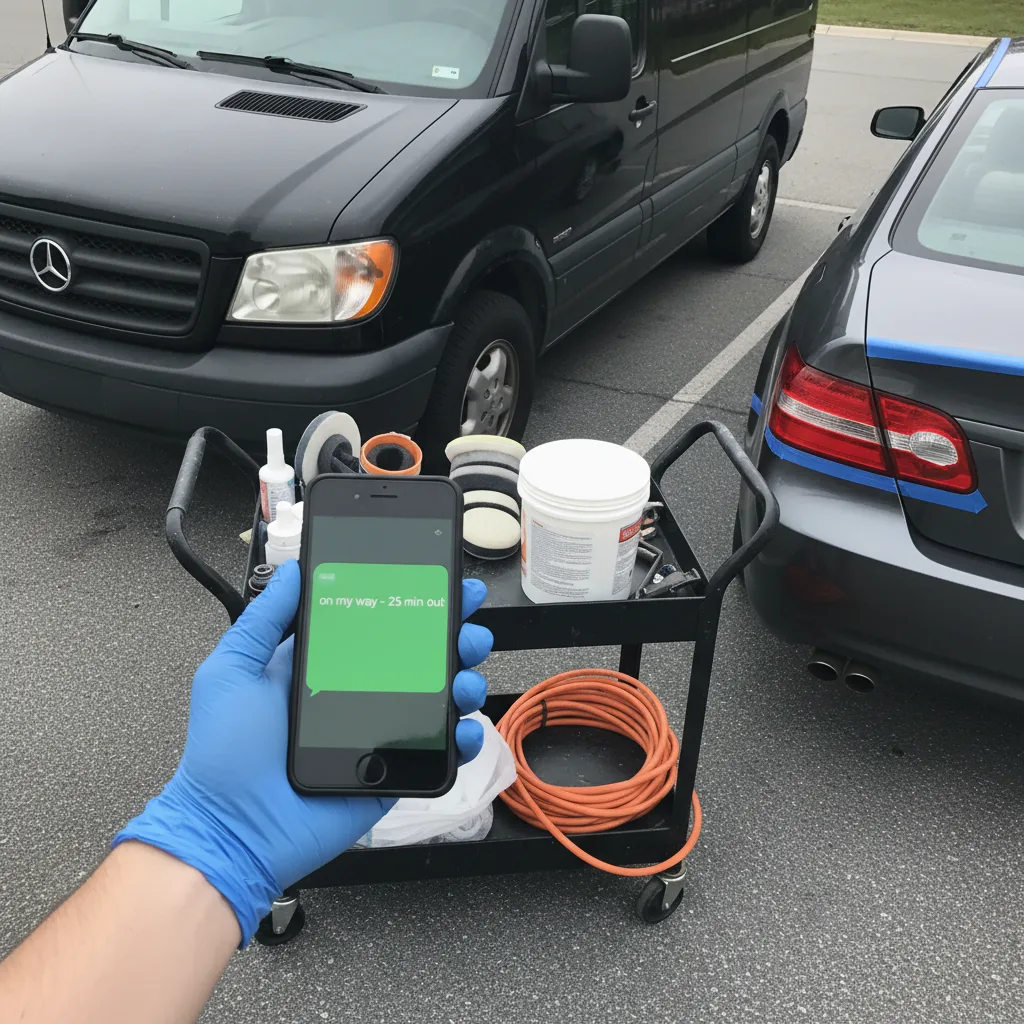
The differentiator is dull. It is reliability and communication. The customer comparing you to the operator they used last year does not remember whether you used Menzerna or Sonax. They remember whether you said you would be there at 9 and arrived at 9, and whether they had to call you to find out where you were. Reliable shows up as 5-star Google reviews. Reviews compound. By year three, the operator who texted "on my way - 25 min" before every job has 40 reviews and is booked four weeks out. The operator who never texted has 6 reviews and is still chasing $80 quick washes.
This is the gap FixyFlow was built to close. The day-before reminder, the on-my-way text with an ETA the customer can actually see, the before-and-after photos auto-organized on a tracking page they can share with their friends, the review ask sent at the moment the job finishes - those are the boring, repeatable things that turn one detail into three referrals. The detailing skill is table stakes. The customer experience is what compounds.
The boring truth about starting a mobile detailing business in 2026 is that the business will not be won on the polish. It will be won on whether you can be the operator who shows up when you said you would, communicates without being asked, and turns every job into a Google review and two referrals. Start cheap. Price fair. Show up. The rest follows.
— Lasse
Built FixyFlow in Collingwood