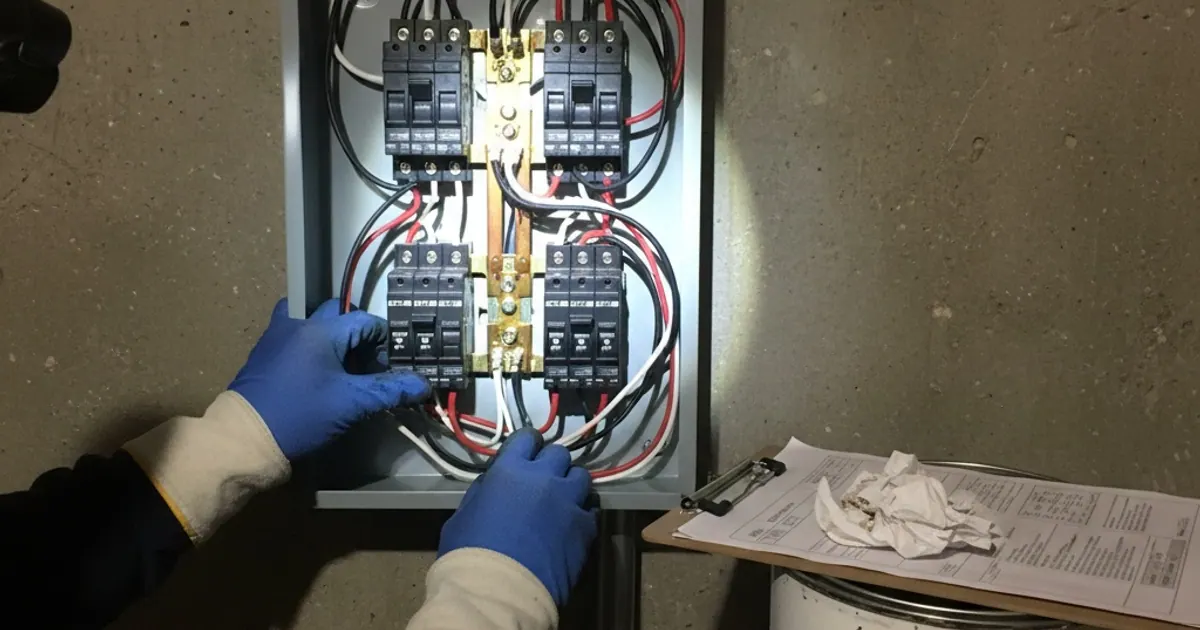
Electrician Hourly Rate in Ontario (2026): Wage vs Billed Rate
Last updated: 2026-09-02 · Rates compiled from published Ontario contractor pricing, Job Bank wage data (NOC 72200) and the ESA 2026 fee guides. Prices move; confirm against your own overhead before you quote.
In 2026, a licensed electrician in Ontario bills somewhere between $90 and $150 per hour for residential work, and the same electrician, as an employee, earns a median of $34 per hour according to Job Bank. Toronto and the GTA sit at $100 to $150 for a journeyperson and $150 to $200 for a master electrician who owns the company, Kitchener-Waterloo-Barrie lands around $95 to $140, and London or Northern Ontario at $80 to $120. Service calls carry a $75 to $200 first-visit fee on top. The gap between $34 and $130 is not greed - it is unbilled hours, a van, insurance, WSIB and the ESA permit, and this post walks all of it through one real job.
Most of what ranks for this search is written for homeowners, and three of the top five results are employee salary pages. If you are the person who has to set the number (and then defend it when the customer says the guy on Facebook quoted half), the salary pages are not much use. So I have tried to write the version I would have wanted when I was helping trades price their work in Collingwood: the rate by region, the maths behind it, the permit line, and what to do with the quote once it leaves your truck.
What does an electrician charge per hour in Ontario in 2026?
The billed rate depends more on where the van is parked than on the licence in the glovebox. Here is the range by region, compiled from published contractor pricing (Grizzli's 2026 survey, City Power in Toronto, Effective Wiring, Blais Electric in Guelph, and Affordable Comfort in Barrie and Collingwood), set beside the Job Bank median wage for the same area so the gap is visible.
| Region | Billed rate, journeyperson | Billed rate, master / owner | Job Bank median wage |
|---|---|---|---|
| Toronto and GTA | $100 to $150 | $150 to $200 | $34.86 |
| Ottawa | $110 to $160 | $150 to $200 | $38.45 |
| Kitchener-Waterloo-Barrie (Collingwood sits in this zone) | $95 to $140 | $140 to $180 | $36.00 |
| Hamilton-Niagara | $90 to $130 | $130 to $170 | $32.00 |
| London | $80 to $120 | $120 to $160 | $29.75 |
| Northern Ontario | $80 to $140 | $120 to $180 | $34.00 (provincial) |
A few things the table hides. Apprentices bill $50 to $80 where a contractor bills them out at all. Almost every company has a minimum, usually one hour on weekdays and two hours on evenings and weekends. And the numbers for Collingwood specifically are thin - I could not find a single published Collingwood hourly rate, so the Barrie band is the closest defensible figure (Affordable Comfort, which serves both towns, quotes $100 to $200 per hour for Ontario and then prices most jobs flat).
Homeowners see the same spread from the other side. A London, Ontario homeowner asking Reddit for the going rate was told "generally between $85-$120", which matches the London row almost exactly. The HomeStars 2026 guide puts residential work at $80 to $150 per hour with the first hour of a service call billed higher. So the market knows the range. What it does not know is why.
Why is the billed rate four times the wage?
Because you only get paid for the hours you bill, and you pay yourself for all of them. A one-van electrical contractor working a full year has 2,080 hours available and, in practice, bills 1,100 to 1,200 of them (Hey Jodie's guide uses 25 billable hours a week over 47 weeks, which is 1,175). The rest is driving between jobs, writing quotes, chasing parts, sitting on hold with the supplier, and the Tuesday afternoon that fell through because the customer forgot you were coming.
Take a $65 per hour wage, which is what a good journeyperson with a few years of service work is worth to you as an owner (and roughly what you would pay yourself). Spread 2,080 hours of that wage over 1,175 billable hours and the wage alone costs $115 per billable hour. Then add the overhead, which for a solo operator in Ontario lands somewhere around $25,000 to $35,000 a year:
- Van, fuel, tools and stock: $1,500 to $2,800 per month is Grizzli's estimate per vehicle, and a service van that is not stocked cannot do flat-rate work profitably (more on that below). Call it $18,000 to $30,000 a year, or $15 to $26 per billable hour. This is the single biggest line.
- Insurance: the ESA requires $2,000,000 in liability coverage to hold a contractor licence. McLean & Dickey puts a basic electrician policy at $500 to $1,000 a year, rising to $3,000 or more with a truck and higher limits. Under $2 per billable hour.
- WSIB: electrical work is Class G4 (building equipment construction) at $1.54 per $100 of insurable earnings for 2026, and sole proprietors in construction are covered whether they have employees or not. On a $65 wage that is about $1 per hour. (The lawn-care crowd has a similar surprise waiting; the lawn care insurance post covers the construction classification trap.)
- Licences: the Electrical Contractor licence is $448 per year and the Master Electrician licence $91, as of April 1, 2026. About 46 cents per billable hour, which is why licence fees never explain a rate and the van always does.
Put it together: $115 for the wage, roughly $26 for overhead, and you are at $141 before any margin. Add 10 to 15 percent so the business can survive a slow February and you land at $155 to $162. Grizzli summarises the same arithmetic in one line I keep coming back to: you have to bill "$110 to $140 per hour just to net $35 to $50 per hour". While the exact figures depend on your hours and your van payment, technically the shape of the maths does not change - the wage is the floor and the unbilled time is the multiplier.
What does an ESA permit really cost, and who pays it?
Every electrical job in Ontario that goes beyond like-for-like replacement needs a notification filed with the ESA, and the fees went up 1.9 percent on April 1, 2026. The 2026 Residential Fees Reference Guide is the document to keep in the truck; the numbers below are the contractor rate, with the non-contractor (homeowner) rate in brackets where it differs.
| Notification | Contractor fee (2026) |
|---|---|
| Minimum notification fee | $92 |
| Service change, panel change, new service to existing structure | $86 ($212 non-contractor) |
| EV charger circuit | $86, plus $30 each additional ($93 plus $33) |
| Additions and alterations, no service work: 1 to 10 outlets | $46 |
| Additions and alterations, no service work: 11 to 30 / 31 to 40 / 41 plus outlets | $92 / $143 / $201 |
| Additions with service work: 1 to 10 / 11 to 30 / 31 to 40 / 41 plus outlets | $105 / $150 / $201 / $256 |
| Same-day or emergency inspection | $174 per hour on top (2025 guide) |
Now compare that with what the market quotes. Ottawa Electric Service tells homeowners to expect $100 to $200 for an EV charger permit and $150 to $250 for a panel upgrade, and says plainly that permit fees are included in the quoted price. Kolji Bros in the GTA lists the ESA line on an EV install at $100 to $250. Blais Electric in Guelph quotes $95 to $150. H MAN Electric in Toronto goes the other way and prints "permit fees and taxes are not included" on its pricing page. So the permit that costs a contractor $86 to $105 is quoted at $100 to $250 across the province, and the customer is happy to see a line called "ESA permit" because it proves the work will be inspected.
Two things to get right on the permit line. First, ESA issues a Certificate of Acceptance (a lot of contractors and most homeowners still call it the Certificate of Inspection) once the work passes, and the contractor who filed the notification should hand the homeowner a copy - homeowners call back two years later asking for it when they sell, and the ones who have to file an Access to Information request with ESA remember who did not give it to them. Second, the minimum fee is $92 whether the job is one hour or forty, so a $150 outlet job with a permit is a very different margin picture from a $3,500 panel with one.
Walk one job: a 200 amp panel upgrade in Barrie
Rate tables are abstract, so here is one job from wage to invoice. A 200 amp panel upgrade in Ontario currently prices at $2,500 to $4,500 (Wilson Electric in Whitby gives that range, City Power quotes $3,200 to $4,500 in Toronto). Wilson breaks out the extras that push a job to the top of the range: meter base $300 to $700, service cable $400 to $900, and the Hydro One or local utility reconnect at $150 to $300. Assume a Barrie job that lands at $3,600 all in, with the customer supplying nothing.
| Line | Amount | Note |
|---|---|---|
| Labour: 9 hours at $130 | $1,170 | Barrie band, journeyperson plus owner on site for the cut-over |
| Panel, breakers, service cable, meter base, sundries | $1,500 | Marked up from supplier cost; varies with the brand and the cable run |
| Utility disconnect and reconnect | $250 | Passed through; Hydro One timing is the schedule risk on this job |
| ESA notification (service change) | $200 | Costs the contractor $86; quoted in the $150 to $250 market band |
| Contingency and quote allowance | $480 | The hour of quoting, the second visit for the inspection, the return trip if ESA flags a label |
| Invoice before HST | $3,600 | Middle of the Ontario range |
Now run the contractor's side. Nine billable hours at $130 is $1,170, which at the $115 wage-per-billable-hour figure above leaves about $135 to cover overhead on this job, and the overhead allocation for nine hours (at $26 per hour) is $234. So the labour line on its own loses money, and the job only works because of the material markup, the permit line and the contingency allowance. That is not a trick; it is how every trade that carries materials prices work, and it is why the "just charge $130 an hour" advice on forums undersells what a panel actually needs to bill. It is also why one Mike Holt Forum member (brantmacga) puts it as bluntly as anyone: "you need a stocked service vehicle to do flat-rate service profitably". The van is the margin.
How do service calls and after-hours rates work for electricians?
Electricians price the first hour differently from plumbers, and it is worth understanding the pattern before you copy a competitor. Three structures show up repeatedly in Ontario pricing pages:
- Diagnostic fee, then flat rate. H MAN Electric charges $200 for the first troubleshooting hour and $100 per hour after. On the Mike Holt Forum, mtnelect describes the version I like best: "On service calls I charge a 'Diagnostic Charge' of $75.00. When the problem is identified a 'Flat Rate' is given for the complete repair and if approved by the customer I waive the 'Diagnostic Charge'." The waiver is the closing tool.
- Service-call minimum. City Power in Toronto sets a $150 to $250 minimum; Grizzli's survey has $75 to $200 across the province and $100 to $200 in Toronto. One hour minimum weekdays, two hours evenings and weekends is the default.
- After-hours surcharge rather than multiplier. Plumbers and HVAC techs lean on 1.5x and 2x multipliers; electricians more often add a flat $100 to $200 on top of the standard rate, with 2x reserved for statutory holidays and overnight GTA calls running $200 to $400 per hour. A US electricianTALK member (mechanicaldvr) runs "$130 per hour with a trip charge for diagnostic" and "2x rate plus trip charge with a 2 hour minimum" overtime, which is close to what I see in Ontario too. The after-hours pricing post goes deeper on when a multiplier beats a surcharge.
Whichever structure you pick, print it. Growler on the same forum, answering a "quote too high" complaint: "If there was a price quote up-front then it doesn't matter. Price Quote = invoice amount. End of story." A written first-hour fee is the difference between a customer who feels informed and a customer who feels ambushed, and the second kind writes the review.
The permit is not your margin. The follow-up is.
Here is the part none of the rate pages cover. At $130 per hour and 1,175 billable hours, a solo electrician grosses about $150,000 in labour a year. The permit line on a panel job adds maybe $100 of margin. A single unanswered $3,600 panel quote costs 36 times that. And panel quotes go unanswered constantly, because the customer asked three electricians, two of them emailed a PDF, and all three went quiet.
The pattern is the one the missed-call cost post lays out for phone calls: the money is not in the rate, it is in the jobs that never close. A quote that is texted the same afternoon, with a one-line "this includes the ESA permit and the Hydro reconnect, I can hold the 14th if it works for you", gets an answer. A PDF on Thursday night does not. So spend the hour you would have spent agonising over $125 versus $135 on the follow-up rhythm instead: quote the same day, text it (people open texts; they file emails), and follow up once on day two and once on day five. Then use the hourly rate calculator to check your number against your own overhead rather than against the guy on Facebook.
If you want the status side handled while you are inside a panel, FixyFlow texts the customer automatically as the job moves from booked to in progress to done, with a tracking page they can open without logging in. The free plan covers a solo operator and the Starter tier is $19 a month, which at a $130 rate is about nine minutes of billable time. Not a sales pitch so much as a proportion: nine minutes a month to stop the "is the inspector coming today?" calls. Details on the pricing page.
What the rate tables will not tell you
- The Job Bank median ($34) is an employee wage and a lagging one (reference period 2023 to 2024). Use it to sanity-check what you pay a journeyperson, not what you bill.
- ESA's own FAQ page still quotes the minimum residential notification at $88; the 2026 guide says $92. Trust the PDF.
- Master electrician exam eligibility is three years as a journeyperson under a valid C of Q, and the licence requires the ME to be on staff at all times. If you are the only ME in the company, your rate has to cover the days you cannot be on the tools.
- Pot lights ($100 to $350 per light depending on the city and the count), outlets ($120 to $250) and EV chargers ($1,500 to $3,000 installed) are flat-rate jobs almost everywhere now. The hourly rate is what you use to build the flat price, not what the customer sees.
- Plumbers went through the same wage-to-rate arithmetic in the Ontario plumber rate post, and the overhead structure is nearly identical; what differs is the permit regime and the after-hours model.
While there is no single right number for an Ontario electrician, technically there is a wrong one: any rate that was set by looking at a competitor's website instead of your own van payment. Work the maths once, write the first-hour fee down, and then put the effort where the money actually leaks, which is the quote sitting unanswered in somebody's inbox.
Sources: Job Bank, electricians (NOC 72200), Ontario; Grizzli, electrician charges per hour in Ontario; City Power, Toronto electrician cost; Effective Wiring; Blais Electric, Guelph; H MAN Electric pricing; Affordable Comfort, Barrie and Collingwood; Wilson Electric, panel upgrade cost; Kolji Bros, EV charger cost; ESA 2026 Residential Fees Reference Guide; ESA 2026 licensing fees; ESA Certificate of Acceptance; ESA Master Electrician exam; Ottawa Electric Service permit guide; WSIB 2026 premium rates; McLean & Dickey on electrician insurance; Hey Jodie, what to charge as an electrician; Mike Holt Forum, hourly rate vs flat rate; Mike Holt Forum, quote too high; electricianTALK, fees and emergency rates; HomeStars electrician cost guide. Forum quotes are from US contractors; the Ontario figures are from Ontario pages. The Barrie panel job is an illustration built from the cited ranges, not a real invoice.
- Lasse / Built FixyFlow in Collingwood