Lawn Care Business Insurance: Real 2026 Costs and Gaps
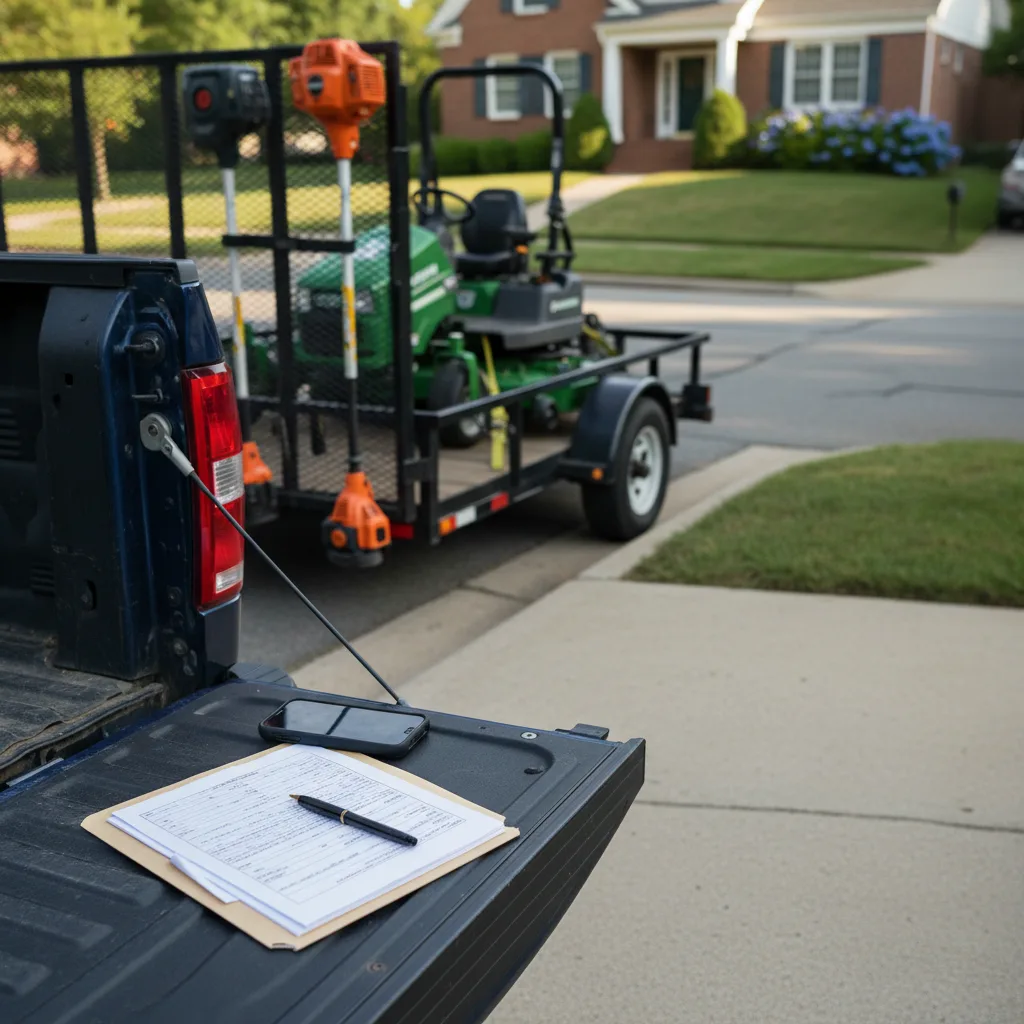
A mower blade catches a stone, the stone clears the discharge guard, and it puts a hole in the window of a truck driving past. That is the classic lawn care claim, and on the forums where operators compare notes the repair bills run $380 to $400 for a single pane of truck glass. Here is the short answer to what protecting yourself costs in 2026: general liability for a lawn care business runs about $46 to $51 per month at the median, with the full stack (liability, commercial auto, tools coverage, workers' comp if you have a crew) landing anywhere from $80 a month for a careful solo operator to $400+ for a crew with two trucks. The dollar figures are the easy part. The gaps are what actually sink people, and this post spends most of its time there.
What does lawn care business insurance actually cost in 2026?
Here is the honest table, built from published customer data at Insureon (median premiums, updated February 2026) and NEXT Insurance (customer percentiles, July 2026):
| Coverage | Median cost (US) | What it actually covers |
|---|---|---|
| General liability ($1M/$2M) | $46-$51/mo | The flung stone, the trip-and-fall, damage to a customer's property. 94% of landscaping businesses pick exactly $1M/$2M limits. |
| Tools & equipment (inland marine) | $32-$38/mo | Theft or damage to mowers, trimmers, blowers - on the trailer, at the shop, or on a job site. |
| Commercial auto | $190-$205/mo | Your truck while it is working. Your personal policy excludes this - more below. |
| Workers' compensation | $150-$169/mo | Required in 49 states once you hire. Scales with payroll. |
| Commercial umbrella | ~$88/mo per $1M | Extra liability on top of GL. Usually a later-stage buy. |
| Pesticide/herbicide endorsement | ~$100-$175/yr | Application coverage standard GL excludes. Legally required for licensed applicators in many states. |
If you are pricing your services and want to know what these overheads do to your required hourly rate, run the numbers through our free hourly rate calculator - insurance is one of the line items solo operators most often forget to load into their price.
Why does every insurance site show you a different number?
Because they are measuring different things, and almost nobody says so. Insureon and NEXT publish medians of what their actual customers pay, which is how you get figures like $46/month. MoneyGeek's 2026 report publishes average quoted rates, which is how you get $197/month for the same general liability policy. Both are real numbers. A solo operator with no claims history and no crew lands near the medians; a 5-person crew in California gets quoted like the averages. MoneyGeek's state spread makes the point: the same GL policy averages $120/month in West Virginia and $349/month in California. When a broker quotes you triple what a comparison site promised, this methodology gap is usually why, not (necessarily) the broker padding it.
And while operators argue about $46 versus $197, the claims themselves are getting more expensive: The Hartford's 10-year claims analysis found the average customer-injury claim more than doubled from $20,000 in 2015 to $45,000 in 2025. The premium is not the number that hurts you.
Why doesn't your truck insurance cover the mowers on the trailer?
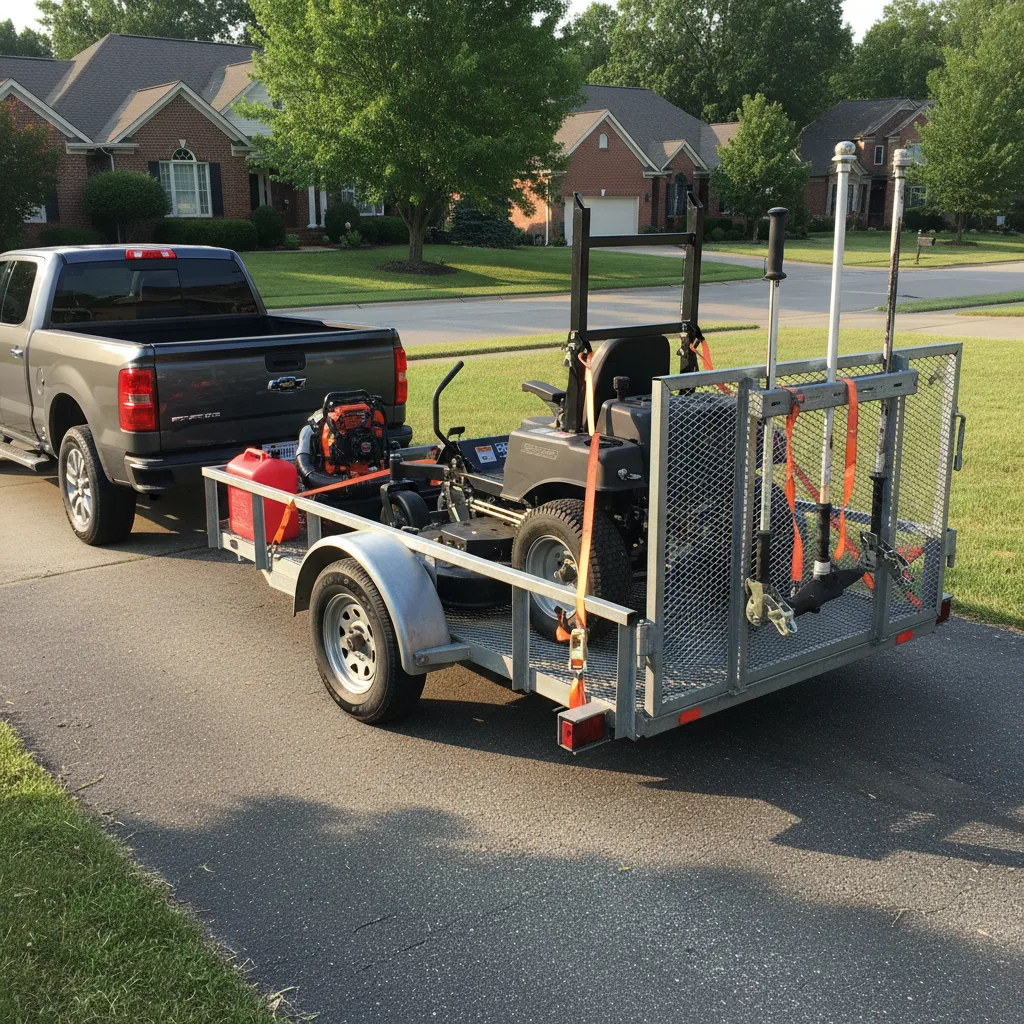
This is the gap that produces the worst forum threads. A crew on LawnSite woke up to find their truck, trailer, and roughly $20,000 in equipment stolen from their own driveway. Police recovered the truck and trailer. The equipment was gone. Then the second hit landed:
"We are licensed and have liability insurance, but not theft policy on equipment. Our vehicle insurance does not cover anything attached to our vehicle... Guess we were just a little too comfortable since we've been in the business for 10 years and never lost more than a blower."
Ten years in, fully licensed, carrying liability - and $20,000 of gear uninsured, because general liability covers damage you do to other people, not your own equipment, and auto policies stop at the hitch. Homeowners insurance will not rescue you either; it excludes business equipment beyond token limits unless you add a rider. The fix is a separate inland marine (tools and equipment) policy. Another operator in the same thread: "I think I got about 30k in stuff insured on a seperate policy for about 300 a year." Three hundred dollars a year against a $20,000 morning. If your gear list has crept past $10,000 (most people who followed our starting-a-landscaping-business guide crossed that in year one), this policy stops being optional.
Does your personal auto policy cover you towing a work trailer?
Usually no, and this trap catches almost every operator who started as a side hustle. Personal auto policies exclude business use. Towing a trailer full of commercial equipment to a paying job is unambiguously business use, and if you crash on the way, the carrier can deny the entire claim - vehicle, liability, all of it. Some carriers will cover light commercial use under an "artisan use" rating on a personal policy, which is worth asking about while you are small, but get the answer in writing. Commercial auto at roughly $190 to $205 a month is a real cost (we count it in our true cost of running a service vehicle breakdown), but it is priced against the alternative of personally owning a highway injury claim.
Why do commercial clients ask for a certificate of insurance?
Here is the reframe that makes insurance stop feeling like pure overhead: a certificate of insurance (COI) is a sales document. Property managers, HOAs, and commercial accounts will not let an uninsured operator bid. On LawnSite, an operator asked whether adding a client as an additional insured was worth the hassle, and the replies drew the line clearly - residential customers almost never ask, property managers almost always do. No COI means the contract quietly goes to the company that has one.
The mechanics: the certificate itself is free from your insurer, and an additional-insured endorsement typically costs $25 to $50 per client. Newer carriers like NEXT and Thimble issue digital COIs same-day from an app, which matters more than it sounds - when a property manager asks for proof today, the operator who produces it today wins. If commercial contracts are where you want to go (they are the answer to the seasonality problem every landscaping operator knows too well), the $50/month GL policy is the price of entry to that market, not a tax on it.
Do you need special insurance to spray pesticides or herbicides?
Almost certainly yes, and this is the most under-covered gap in every top-ranking article on this topic. Two separate problems stack here. First, standard general liability policies exclude pesticide and herbicide application by default. An operator on LawnSite put it plainly: "Std GL on lawn care ops doesnt cover. Need to add back in. Also E&O if you want coverage for application mistakes you make." The endorsement to add it back runs about $100 to $175 per year based on operator-reported figures.
Second, in many states the coverage is not optional: you must show proof of financial responsibility before the state will issue a commercial applicator license at all. Minnesota requires $50,000 bodily injury plus $25,000 property damage minimums, Washington requires $50,000/$50,000, and Indiana requires a $300,000 combined single limit for pesticide application businesses. Minnesota even prohibits policies carrying riders that exclude pesticide misuse. If fertilization and weed control are on your menu and your policy has never mentioned the word "pesticide," assume you are not covered until your broker proves otherwise.
Can you pause your insurance for the winter?
The instinct is universal in northern markets: why pay for mowing liability in January? The answer from operators who have run the math is that you mostly are not paying for it. Business premiums are calculated on payroll and revenue, and yours drop to near zero in winter anyway. Cancelling outright creates a coverage-lapse record that raises your renewal rates, leaves your stored equipment naked against theft and fire all winter (see the $20,000 driveway story above), and if you plow snow, that work needs its own liability coverage regardless. One LawnSite operator's system: pay the full year every July, when cash flow is deepest, and never think about it in January. The legitimate seasonal exception is the genuine part-timer, which is who hourly and short-term policies from Thimble (from $17/month, or even by the hour) actually exist for.

What about lawn care insurance in Canada and Ontario?
The structure is the same, the acronyms change. Commercial general liability for an Ontario landscaper with a $2M limit typically starts around $500 per year, with most small operations landing between $450 and $2,000. The wrinkle is WSIB (the WSIB guide for solo operators works out the exemption and the cost by trade): workers' compensation in Ontario is not a private policy but a mandatory registration, and landscaping work classified as construction has been under expanded compulsory coverage since 2013 - which can capture even independent operators with no employees. (Pure maintenance mowing outside the construction classification can often opt for voluntary coverage instead; the classification is worth confirming with WSIB directly rather than guessing, and Landscape Ontario has documented real fines for operators who skipped registration.) The silver lining: the 2026 average WSIB premium rate is $1.23 per $100 of payroll, the lowest in over 50 years. If you are hiring your first crew member, our Canadian first-hire guide walks through the WSIB registration step by step.
What does job tracking have to do with any of this?
More than you would think, because claims are won and lost on documentation. Back in that broken-window thread, a 2010-era operator described his system: keep a camera in the glovebox, and photograph anything already damaged before you start mowing. That was smart in 2010 and it is table stakes now. When a customer says your mower cracked their basement window, a timestamped photo from before the job started - attached to that specific job, findable in ten seconds - is the difference between your insurer fighting the claim and your premium eating the hit for three years. FixyFlow stores photos against every job automatically, alongside the visit history that proves you were (or were not) on that property the day the damage supposedly happened. If you are still texting yourself photos, our landscape scheduling software guide covers what a proper job record looks like for a solo operator.
Every job. Every photo. Every visit. On record.
FixyFlow keeps timestamped job records, before-and-after photos, and customer updates in one place - the documentation your insurer wants when a claim lands, and your customers want every other day. Free tier, no credit card.
Try FixyFlow free →One last honest note. Roughly 75% of US small businesses are underinsured, and with nearly 693,000 landscaping businesses now operating in the US, the operators who carry real coverage, produce a COI on request, and document their work are competing in a smaller field than the raw numbers suggest. Fifty dollars a month is not what protection costs. It is what looking like a professional costs, and it happens to include the protection.
Sources: Insureon 2026, NEXT Insurance 2026, MoneyGeek 2026, The Hartford via Insurance Journal 2025, Minnesota Dept. of Agriculture, WSIB 2026, Zensurance, Thimble, Hiscox 2023, LawnStarter/IBISWorld 2026, LawnSite operator threads. — Lasse / Built FixyFlow in Collingwood