How to Start a Landscaping Business in Canada (2026 Operator Guide)
Every "how to start a landscaping business" article on the internet in 2026 reads the same. Buy a mower. Make a Facebook page. Drop a flyer in 100 mailboxes. Hire a logo designer on Fiverr. Three months later you are wondering why your "1-3 customers a week" pipeline never grew, your knees ache, and the $4,200 zero-turn you financed sits in the garage four days a week.
This is the version of the guide that says the boring true things. Real Canadian startup numbers, the legal and insurance steps you cannot skip, what pricing actually has to be to survive, the equipment you do not need yet, and the customer-acquisition channels that actually pay back in a small Ontario town.
I have watched landscapers in Collingwood, Barrie, the GTA, and Georgian Bay either build something durable or quit by month 14. The split is rarely about how well they mow. It is almost always about three things: pricing discipline, customer reliability, and how soon they bought equipment they did not need.
Is starting a landscaping business in Canada actually a good idea in 2026?
Yes, for the right operator, in most Canadian markets. Lawn care and landscaping is still one of the cheapest service businesses to start - real startup cost is $4,000-$10,000 depending on whether you buy used or new equipment - and residential demand is structurally strong because most Canadian homeowners have lawns, most have stopped wanting to mow them, and the trade is dominated by either large commercial operations (who lose interest in $40 weekly mows) or unreliable solo operators who quit after 18 months. There is genuine room for an operator who shows up, communicates, and prices fairly.
The catch: it is also one of the easiest businesses to start, which means the local market is full of people who undercharge to win the first 5 customers, then quit when they realize they cannot live on $35 mows. Pricing discipline and the discipline of asking for reviews on day one are what separate the survivors from the churn. Same dynamic we wrote about in our guide to starting a cleaning business in Ontario.
How much does it cost to start a landscaping business in Canada?
Realistic startup cost is $4,000-$10,000 for a solo Canadian operator using a vehicle they already own. Anyone telling you it is "under $500" is leaving out the commercial-grade mower (the $250 Canadian Tire push mower will die inside a season of commercial use), real insurance, and the 90 days of consumables and gas you have to float before the first invoices clear.
Honest equipment breakdown for a solo Canadian operator starting cold:
| Item | Realistic CAD cost | Notes |
|---|---|---|
| Commercial 21" walk-behind mower | $700-$1,400 used / $1,800-$2,800 new | Honda HRX or Toro Commercial - skip residential mowers, they die in 600 hours |
| String trimmer (gas) | $250-$500 | Stihl FS56 or Echo SRM-225 - commercial-grade, parts everywhere in Canada |
| Backpack blower | $400-$700 | Stihl BR600 or Echo PB-580T - skip handhelds, your back will thank you |
| Stick edger | $300-$600 | Optional in year one - many start with just the trimmer turned vertical |
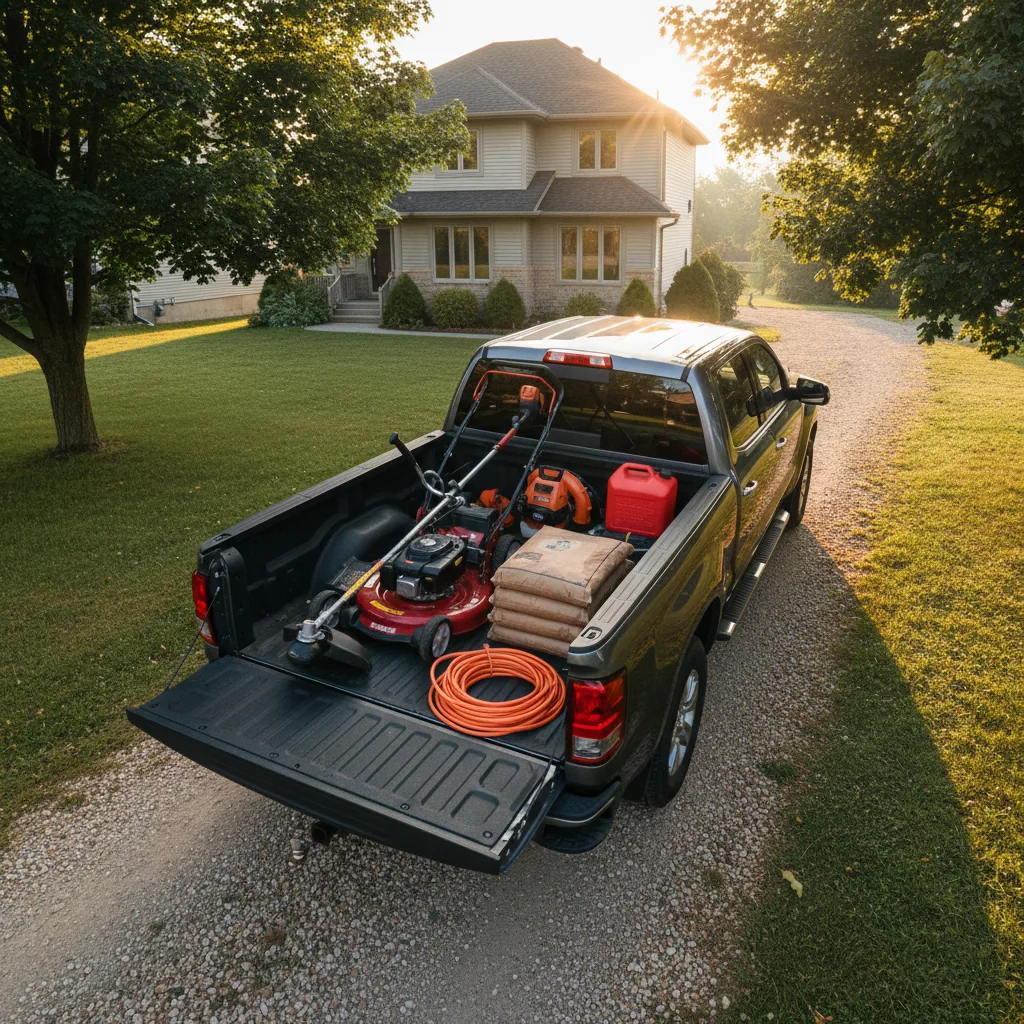
| Trailer (5x10 utility) | $1,500-$3,500 used / $4,000-$6,000 new | Defer until you cross 10 customers - throw it all in the pickup bed first |
| Hand pruners, rakes, shovels, tarps | $200-$400 | Buy as you need them - do not build a hardware store year one |
| Gas, oil, two-stroke mix (90-day float) | $400-$700 | Plan for $80-$150/week in fuel at peak |
| Insurance (annual) | $900-$1,800 | General liability + commercial vehicle endorsement - see below |
| Business registration + HST | $60-$200 | Sole prop fine to start - we cover this below |
| Marketing (GBP, domain, yard signs, flyers) | $200-$500 | Google Business Profile is free, domain $12/yr, the rest is print |
Total at the low end - vehicle you already own, used equipment off Facebook Marketplace, no trailer until customer 10 - is around $4,000-$5,000. At the high end, with a $20,000 zero-turn and a new trailer on financing, you are at $35,000+ before the first cheque clears. Most reasonable starts come in at $5,000-$7,500 in cash, with the zero-turn deferred until year two.
The biggest year-one money mistake we see: buying a zero-turn mower in week one. A $4,500 Ferris is a beautiful piece of equipment. It also pays back zero hours faster than a $1,200 walk-behind until you are mowing 8+ properties per day. Most year-one solo operators mow 3-5 properties per day. The zero-turn is sitting in the garage 60% of the time, depreciating, and the financing is eating the margin on every mow.
Do I need a licence and insurance to mow lawns for money in Canada?
Yes - even as a one-person side hustle, you need general liability insurance, a commercial vehicle endorsement on your auto policy, and a business licence in most Ontario municipalities once you accept paid work. Plan for $900-$1,800/year in insurance plus a $30-$120 annual municipal business licence depending on your city. The "just mow under the table" approach loses one weekend to a customer's broken window from a flung pebble and you are out $1,200 cash plus the customer.
The specifics that matter:
- General liability ($1M-$2M coverage): $600-$1,100/year. Covers a flung pebble through a window, a property-damage incident, slip-and-fall on your work site. The $400 difference between $1M and $2M is worth paying once you start working in higher-end neighbourhoods with $400-$800 worth of damage potential per pane of glass. Quotes from Zensurance and Apollo Insurance are usually 20-30% under brokers for landscaping specifically. We wrote a full breakdown of what lawn care business insurance actually costs in 2026 - including the equipment-theft and pesticide gaps standard policies quietly exclude.
- Commercial vehicle endorsement: $200-$600/year. Your personal auto policy explicitly excludes business use - if you crash on the way to a job, a personal-only policy may refuse the claim entirely.
- Tools and equipment rider: $10-$30/month. Replaces tools stolen from the truck overnight or damaged on site. Worth it once you have $3,000+ in gear.
- WSIB (Ontario) or provincial workers' comp: Required the day you hire your first employee, even a part-time helper. Not needed as a solo operator in most provinces, but you can opt in voluntarily for personal injury coverage.
- HST registration: Mandatory at $30,000 in trailing-12-month revenue. Most second-year landscapers cross this. Register early if you have any commercial accounts - they expect HST on the invoice and your competitor with a number gets the contract.
One thing that surprises a lot of operators: the municipal business licence is often the cheapest and easiest piece, but in some Ontario municipalities (Toronto, Mississauga, Burlington) it is enforced via complaint-driven inspections. A neighbour who does not like your 8am start time will complain to bylaw, and a missing business licence becomes the lever they use to shut you down. Spend the $30-$120 once a year.
Should I register as a sole proprietor or incorporate from day one?
Sole proprietorship is the right answer for almost every new Canadian landscaper in year one. Incorporation makes financial sense once you cross $80,000-$100,000 in revenue, hire your first employee, or land a commercial account that requires it for liability reasons. Premature incorporation costs $1,500-$2,500 in setup plus annual accounting fees that are better spent on equipment or marketing.
The honest path most Ontario landscapers take:
- Register a sole proprietorship with the province ($60-$80) and pick a business name. Get a CRA business number if you do not already have one.
- Open a separate business chequing account. Costs $4-$15/month at most Canadian banks. Critical for separating business income from personal - the CRA expects this.
- Skip the trademark and the logo designer for now. A simple wordmark on a yard sign is fine. Spend the $400 on customer-acquisition.
- Re-evaluate incorporation at the start of year two if you crossed $50,000 in year-one revenue and have a clear path to $100,000+. Talk to a small-business accountant - the calculus is real but it is not urgent.
How should I price weekly mowing vs one-off cleanups in Canada?
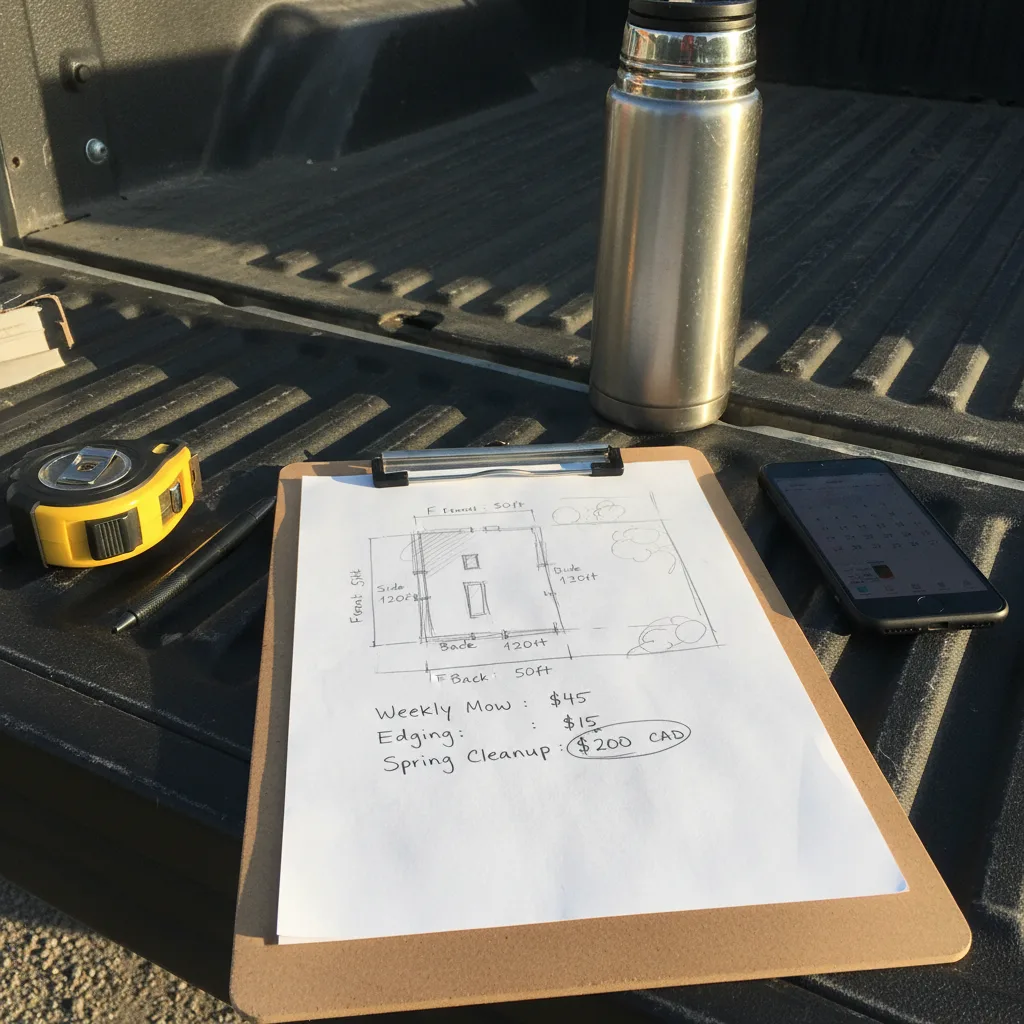
Weekly mowing in Ontario in 2026 is $40-$70 for a standard residential lot, with $50-$55 being the most defensible mid-market price. One-off spring or fall cleanups are $250-$550 depending on property size. Anyone running $30 mows is cutting their own throat - you cannot pay insurance, equipment, and gas at that price.
Workable Canadian package structure in 2026:
| Service | Standard lot (CAD) | Larger / acreage (CAD) |
|---|---|---|
| Weekly mow + trim + blow | $40-$70 | $70-$150 |
| Bi-weekly mow + trim + blow | $55-$85 | $90-$180 |
| Spring cleanup (one-off) | $250-$450 | $450-$900 |
| Fall cleanup (one-off) | $300-$550 | $500-$1,100 |
| Mulch install (per yard) | $120-$180 inc. mulch | same per-yard pricing |
| Hedge trim (per hour or per cubic ft) | $75-$110/hr | $85-$120/hr |
These ranges hold across most of Southern Ontario and the GTA. Rural and small-town pricing runs 15-20% lower at the low end. The numbers worth defending: a weekly mow under $40 cannot pay for itself once you back out drive time, equipment depreciation, gas, and insurance. People charging $30 mows are running themselves into the ground - most of them realize it within a year, some grit through to year two and quit.
Use our hourly rate calculator to back-check your package prices against the true cost of a landscaping hour - including unbillable drive time and equipment depreciation. The break-even hourly rate is almost always higher than new operators think.
What equipment do I actually need to start, and what can I defer?
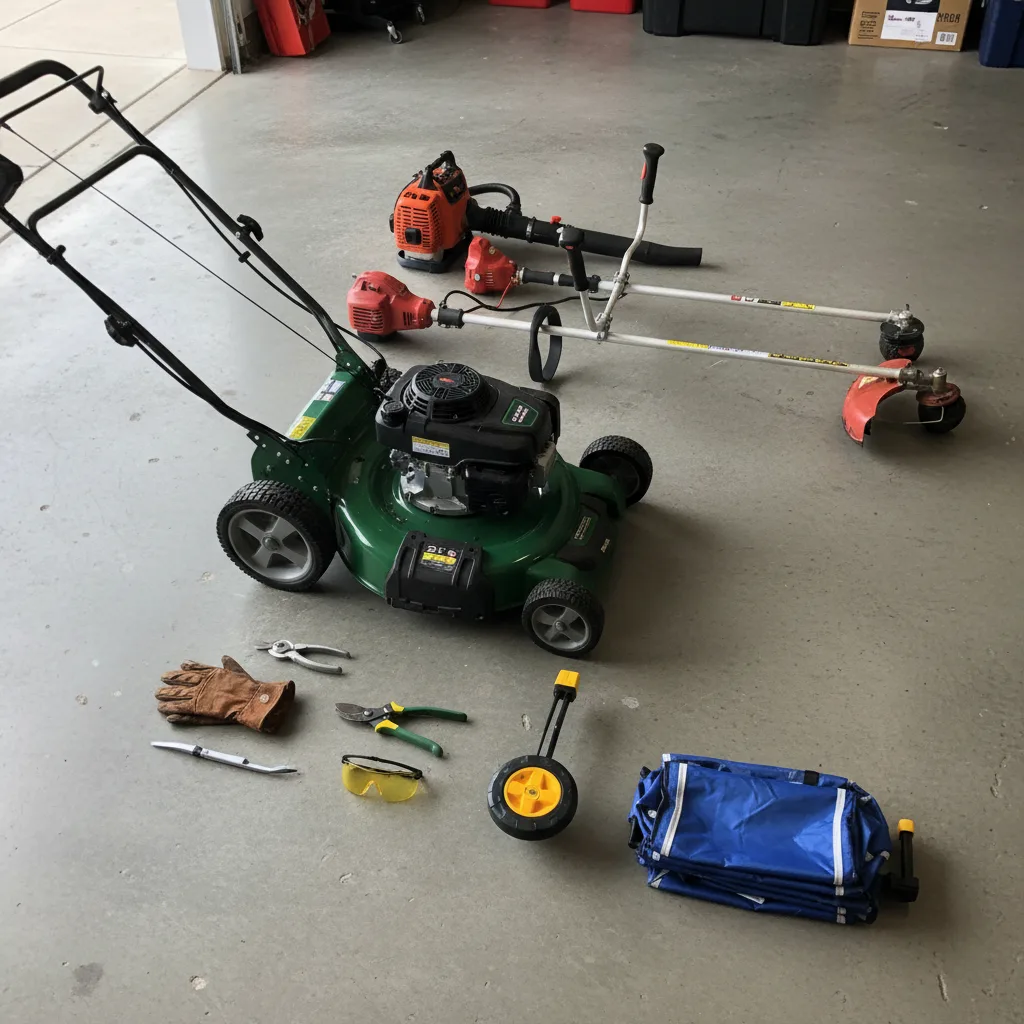
The honest day-one kit for a solo Canadian landscaper is:
- Commercial 21" walk-behind mower (used, $700-$1,400)
- Commercial gas string trimmer ($250-$500)
- Backpack blower ($400-$700)
- Hand pruners, rake, gas cans, two-stroke mix, gloves, eye protection
- The vehicle you already own (van, pickup, or even a hatchback for the first few customers)
What you do not need in week one, despite what equipment dealers will tell you:
- Zero-turn mower. Defer until you are mowing 8+ lawns/day. Until then it sits in the garage 60% of the time, depreciating, eating your insurance.
- Trailer. Defer until you cross 10 weekly customers. Until then, equipment fits in a pickup bed or van.
- Truck wrap or vehicle decals. $1,500-$3,000 to design and install. Yard signs cost $12 and put your name in front of way more eyeballs. Get the wrap in year two if you still want it.
- Stand-on or ride-on aerator. Rent at TaylorRental or Sunbelt for $80-$140/day in your first two seasons. Buy when you are doing 30+ aerations in a fall.
- Snow plow. If you are pivoting to snow removal in winter, that is a separate equipment decision and a separate revenue stream. We will be writing a dedicated guide to starting a snow removal business in Canada soon.
The rule of thumb: any single piece of equipment over $1,500 should be earning you at least $4,000 in margin annually before you buy it. If it cannot pay back in year one, rent it and revisit at year-end.
How do I get my first 15 lawn care customers?
The first 15 customers come from one of three channels: door-to-door in a high-density neighbourhood, hyperlocal Facebook groups, and Google Business Profile + yard signs. Paid Google or Meta ads rarely pay back at the per-customer cost a new solo landscaper can afford. The first 15 customers are about proof and density - good photos, real reviews, and a route tight enough that you can mow 6 lawns in a half-day without burning gas driving.
The order that works:
- Set up your Google Business Profile. Free, requires a real address (your home is fine if you opt to hide it from public display), and ranks above any paid ad in "[your town] lawn care" search results once you have 5+ reviews. Your first 15 customers should each result in a Google review - this is non-negotiable. Send the review-ask SMS within 30 minutes of finishing the job, see our SMS template library for the exact wording that gets the highest reply rate.
- Walk one or two streets door-to-door in a high-density residential neighbourhood near where you live. A printed one-page flyer with three packages and a phone number, handed to the homeowner rather than stuffed in the mailbox, will get you 1-2 customers per 30 doors knocked. Slow, awkward, and the most effective customer-acquisition channel a new landscaper has.
- Post in your local town Facebook group. Not as a paid ad - as a community member offering services. A clean post with before-and-after photos of your first 2-3 jobs (friends' lawns are fine), a clear price list in the first comment, and a phone number gets genuine engagement in most Canadian towns. Most groups allow service posts in moderation.
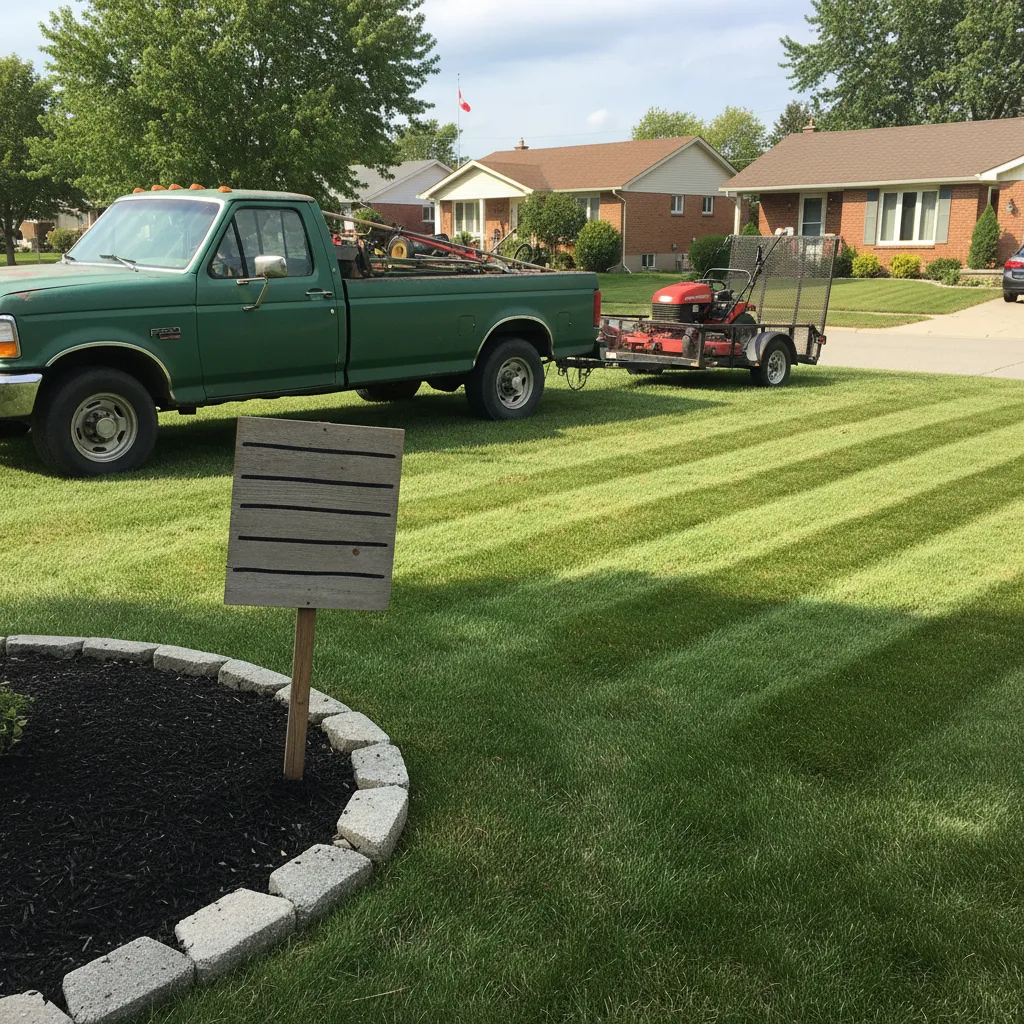
- Plant yard signs at every property you mow. $12 per sign, 15-20 visible signs in a neighbourhood is the most powerful local advertising a residential landscaper has. Customers passing on weekend dog walks see them. Ask permission first - 90% of homeowners say yes.
- Cluster customers on the same street. When you book a new customer, ask them if any of their neighbours might need the same service. The $50 referral discount on next month's service costs almost nothing and turns one customer into a cluster of three within a season.
If you struggle with the review-ask step, the issue is usually friction - asking face-to-face feels weird, and most operators forget. Automating it as a text 30 minutes after job completion solves it.
What does the year-one Canadian landscaping schedule actually look like?
Most articles talk about "reaching profitability in 6 months." The honest picture is more uneven, mostly because Canadian seasonality reshapes the year:
- March-April: Equipment sourcing, business registration, GBP setup, first 5 free or at-cost spring cleanups for friends and family. Revenue: $400-$1,500. Net: negative - you are still buying gas cans and yard signs.
- Late April-May: First paid spring cleanups + early-season mowing starts. Mostly friends-of-friends and door-to-door customers. 4-8 paid jobs/week. Revenue: $2,500-$5,500/mo. Net: roughly break-even after equipment.
- June-August: Peak season. 25-45 weekly mowing customers + landscape one-offs. Revenue: $7,000-$14,000/mo. Net: $3,000-$6,500 after gas, insurance, taxes, equipment maintenance.
- September-October: Strong season - fall cleanups are a real category in Ontario. Revenue: $5,500-$10,000/mo.
- November-March: Off-season. If you have not pivoted into snow removal, gutter cleaning, or holiday lighting, revenue is essentially zero. This is the period that breaks most year-one landscapers - they did not build a winter pivot, did not save the summer cash, and quit by February.
Total year-one revenue for a competent solo operator who survives the off-season is roughly $35,000-$60,000 in most Canadian markets. After equipment, insurance, vehicle costs, and taxes, take-home is typically $18,000-$32,000 in year one, with the bulk of profit in months 5-8.
This is the chart that does not appear in most YouTube videos about starting a landscaping business. The income is real, but it is bunched. Plan your runway accordingly - having 6 months of personal expenses saved before quitting your day job is the single best predictor of who survives year one in this trade.
Should I offer snow removal too, or stay seasonal?
Most successful Canadian landscapers eventually pivot into snow removal because it solves the winter revenue cliff - but it is a separate equipment investment, separate insurance, and a different operating rhythm. Doing both is the durable path; doing only landscaping means living off summer cash for 5 months. Doing both also means roughly doubling your equipment cost in year one if you push the snow side too early.
The common pattern that works: year one, focus on landscaping. Save aggressively. Year two, layer in snow removal with one truck + a plow, starting with the customers you already mowed all summer. Year three, decide whether to scale the snow side commercially. Most landscape software (Jobber, Service Autopilot, Yardbook) handles the dual-season scheduling - your customer list, schedule, and billing stay unified.
We will be publishing a dedicated guide to starting a snow removal business in Canada in the next few weeks - until then, the boring summary is: it is a viable winter pivot if you already have the customer list, and it is a brutal new business if you start it cold.
What separates the landscapers who survive past year two?
By month 24, more than half of the operators who started with you will be gone. The ones who stay are not the ones who own the nicest mower. They are the ones who answered the phone, showed up on time, sent the customer a text the day before to confirm, and never let a Google review request fall through the cracks.
The differentiator is dull. It is reliability and communication. The customer comparing you to the landscaper they used last year does not remember whether you used a Honda or a Toro. They remember whether you said you would be there at 9 and arrived at 9, and whether they had to call you to find out where you were. Reliable shows up as 5-star Google reviews. Reviews compound. By year three, the operator who texted "on my way - 25 min" before every job has 50 reviews and is booked four weeks out. The operator who never texted has 8 reviews and is still chasing $35 mows.
This is the gap FixyFlow was built to close. The day-before reminder, the on-my-way text with an ETA the customer can actually see, the rain-day batch reschedule that turns 12 individual texts into one button, the review ask sent at the moment the job finishes, the photo of the freshly mowed lawn that auto-attaches to the customer's timeline - those are the boring, repeatable things that turn one weekly mow into three referrals from the same street. The landscaping skill is table stakes. The customer experience is what compounds.
The boring truth about starting a landscaping business in Canada in 2026 is that the business will not be won on the equipment. It will be won on whether you can be the operator who shows up when you said you would, communicates without being asked, prices fairly enough to last, and turns every weekly mow into a Google review and two referrals. Start cheap. Price fair. Show up. The rest follows.
— Lasse
Built FixyFlow in Collingwood